
What’s Better in Bali: Renting a Scooter or Using Grab and Gojek Every Day?
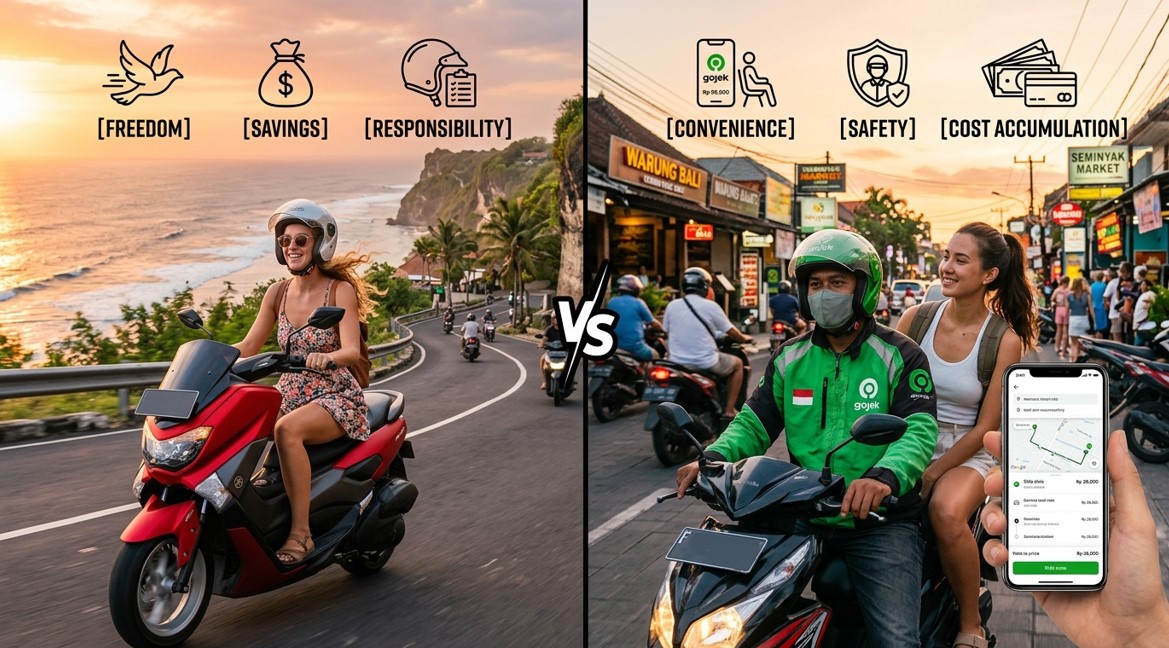 Choosing between renting a scooter or relying on Grab and Gojek for daily transportation in Bali fundamentally depends on your trip frequency, legal preparedness, and risk tolerance. For travelers making more than four trips daily who possess a valid International Driving Permit, scooter rental typically costs 40-60% less over a two-week stay compared to ride-hailing services, while offering significantly greater spontaneity. However, this cost advantage evaporates entirely when factoring in the risk exposure from Indonesia’s accident rate of 73.2 per 100,000 population as of 2023, particularly for riders unfamiliar with local traffic patterns.
What Is the Real Cost Difference Between Renting a Scooter and Using Grab/Gojek Daily?
The financial comparison between scooter rental and ride-hailing services in Bali operates on a breakeven threshold that shifts based on daily trip frequency and rental duration. Scooter rental becomes economically superior when you exceed four medium-distance trips per day over a period of at least ten days.
How Much Does Scooter Rental Actually Cost When You Include All Expenses?
A typical automatic scooter rental in Canggu or Seminyak costs between 50,000 and 70,000 Indonesian Rupiah daily for short-term rentals under one week. Monthly rentals drop to approximately 700,000-900,000 IDR, averaging 25,000-30,000 IDR per day. Beyond the rental fee, fuel consumption adds another 15,000-20,000 IDR daily for moderate usage of 30-40 kilometers, given petrol prices of approximately 10,000 IDR per liter and scooter fuel efficiency of 35-40 kilometers per liter. Parking fees accumulate to roughly 5,000-10,000 IDR daily across multiple destinations, though many beach clubs and restaurants in tourist areas offer free parking. The deposit, typically 1,000,000-2,000,000 IDR or passport hold, represents locked capital rather than an expense, assuming the vehicle returns undamaged. Total daily operational cost for scooter rental settles between 70,000-100,000 IDR when accounting for all direct expenses, excluding insurance gaps and legal compliance costs.
What Are the True Daily Costs of Using Grab and Gojek for All Your Trips?
Grab and Gojek pricing in Bali operates on a per-kilometer model with base fares and dynamic surge multipliers during peak hours from 8-10 AM and 5-8 PM. A typical GrabBike trip from Canggu to Seminyak covering approximately 6 kilometers costs 15,000-22,000 IDR during normal hours and 22,000-32,000 IDR during peak periods. GrabCar for the same route ranges from 35,000-50,000 IDR, escalating to 50,000-70,000 IDR with surge pricing. A conservative daily usage pattern for a digital nomad or active tourist might include morning coworking commute, lunch destination, afternoon beach or shopping trip, and evening restaurant visit, totaling four trips averaging 5-7 kilometers each. Using exclusively GrabBike, this pattern generates daily costs of 80,000-120,000 IDR during mixed peak and off-peak hours. Choosing GrabCar instead would elevate daily expenses to 180,000-260,000 IDR. The variability in ride-hailing costs stems from both surge pricing unpredictability and driver availability, which contracts significantly during rain or high-demand windows.
At What Trip Frequency Does Scooter Rental Become More Economical Than Ride-Hailing?
The breakeven analysis reveals that scooter rental achieves cost parity with GrabBike at approximately 3.5 trips per day over a 14-day period, assuming average trip distances of 6 kilometers and standard rental rates. Choosing between renting a scooter at 80,000 IDR daily total cost versus using GrabBike incurs a crossover point where 3.5 trips at 20,000 IDR each equals 70,000 IDR, approaching the scooter’s daily operational expense. Over a two-week stay with five trips daily, scooter rental totals approximately 1,120,000 IDR compared to GrabBike’s 1,680,000 IDR, representing a 33% cost reduction. The economic advantage compounds over longer stays, with monthly scooter rental delivering 900,000 IDR total cost versus an equivalent GrabBike usage pattern consuming approximately 2,800,000 IDR monthly. However, this calculation excludes the “hidden surcharge” of legal risk, as operating without proper licensing can result in on-the-spot fines from traffic police ranging from 250,000 to 1,000,000 IDR, which a single violation can eliminate weeks of accumulated savings.
How Did Bali’s Transportation Landscape Transform Over the Past Decade?
Prior to 2015, Bali’s transportation ecosystem for tourists relied almost entirely on negotiated arrangements with traditional taxi drivers, hotel shuttle services, and informal motorcycle taxi networks locally known as “ojek.” These traditional ojek operated without metered pricing, requiring verbal negotiation for every trip, which created significant transaction friction and price opacity. Tourists frequently paid inflated rates due to information asymmetry, with a 5-kilometer trip costing anywhere from 30,000 to 100,000 IDR depending on negotiation skill and driver disposition. Traditional Blue Bird taxis offered metered reliability but remained scarce outside major tourist corridors and charged premium rates averaging 7,000-8,000 IDR per kilometer.
The launch of Gojek in Bali around 2015, followed by Grab’s aggressive expansion in 2016-2017, fundamentally restructured the market by introducing transparent, app-based pricing and GPS tracking. Early adoption faced violent resistance from traditional taxi cartels, with documented incidents of ride-hailing drivers being physically assaulted at certain hotel zones and beach clubs. Some establishments in Seminyak and Nusa Dua initially banned Grab and Gojek pickups to protect relationships with traditional taxi operators. This resistance created a brief experimental period where hybrid services like “GrabTaxi” attempted to integrate traditional metered taxis into the app ecosystem, but these failed to gain traction due to pricing non-competitiveness and the incumbents’ reluctance to adopt digital dispatch systems.
The current dominance of Grab and Gojek emerged because they solved the predecessor’s core problems through price transparency, driver accountability via rating systems, and cashless payment options. By 2023, ride-hailing services captured an estimated 65-70% of the tourist transportation market in major Bali districts, according to industry analysis from the Indonesian Ride-Sharing Association. The scooter rental market simultaneously professionalized, with established operators like BaliRentalScooter and Bali Bike Rental replacing informal roadside rental shops, introducing standardized contracts, helmet provision, and rudimentary insurance products. The technological evolution from negotiated cash transactions to app-based transparent pricing represents the sector’s most significant structural shift, fundamentally altering the tourist experience by eliminating the negotiation tax that previously inflated transportation costs by 40-70% compared to current ride-hailing rates.
What Are the Legal Requirements and Safety Risks of Each Transportation Option?
Legal compliance and accident liability differ fundamentally between self-operated scooter rental and passenger status in ride-hailing services, creating asymmetric risk profiles that most short-term visitors underestimate until encountering enforcement or incident scenarios.
What Documents Do You Actually Need to Legally Ride a Rental Scooter in Bali?
Indonesian traffic law requires foreign nationals to possess either an International Driving Permit with motorcycle classification or a locally issued SIM C license to legally operate a scooter in Bali. The IDP must be accompanied by your valid home country driver’s license, and critically, your home license must explicitly include motorcycle or two-wheeler authorization for the IDP to be valid for scooters. A standard car-only driver’s license with an IDP does not confer legal authority to operate motorcycles in Indonesia, despite many rental agencies failing to verify this distinction. Traffic police enforcement varies by location and time, with documented checkpoint frequency highest in Seminyak, Sanur, and central Denpasar, while Canggu and Uluwatu see more sporadic enforcement. Penalties for operating without proper licensing officially range from 250,000 IDR fines to potential vehicle impoundment, though on-the-spot “settlement” negotiations often resolve violations for 200,000-500,000 IDR depending on officer discretion and negotiation dynamics.
Beyond licensing, helmet use is legally mandatory for both rider and passenger, with violation fines of approximately 250,000 IDR. Rental agencies typically provide one basic helmet, though quality varies dramatically from thin novelty helmets offering minimal protection to certified full-face options. The legal requirement exists independently of what the rental agency provides, placing compliance burden on the rider. Foreign visitors also face amplified consequences in accident scenarios if operating without proper documentation, as Indonesian insurance policies typically contain explicit exclusions for unlicensed operators, leaving you personally liable for all damages, medical expenses, and potential third-party claims.
How Do Insurance and Liability Differ Between Scooter Rental and Ride-Hailing Services?
Grab and Gojek drivers in Indonesia are required to carry third-party liability insurance covering passenger injury up to 25,000,000 IDR for death and 5,000,000 IDR for medical expenses per incident, as mandated by the Ministry of Transportation’s ride-hailing regulations implemented in 2019. As a passenger, you assume zero operational liability for traffic violations or accidents caused by driver error. Your primary risk as a ride-hailing passenger is limited to injury from accidents, with your own travel insurance typically covering medical expenses beyond the driver’s liability policy limits. The ride-hailing platform’s insurance structure shifts all legal and financial liability for traffic incidents to the driver and their insurance carrier, insulating passengers from claims by third parties.
Conversely, rental scooter operations place you as the legal operator responsible for all damages, injuries to third parties, and vehicle repair costs. Most rental agreements in Bali explicitly state that the renter bears full financial responsibility for any damage to the vehicle, regardless of fault determination. Standard rental contracts do not include collision damage waiver or theft protection, leaving you exposed to the full replacement value of the scooter, typically claimed at 15,000,000-25,000,000 IDR even for vehicles with obvious depreciation. Some premium rental operators offer optional daily insurance for 25,000-50,000 IDR that reduces your damage liability to a fixed excess of 2,000,000-3,000,000 IDR, but this coverage typically excludes scenarios where you operated without valid licensing or under influence. Choosing to rent a scooter without understanding this liability asymmetry means accepting potential exposure to claims that could reach 50,000,000-100,000,000 IDR in serious accidents involving injury to other motorists or pedestrians, amounts that would pursue you through international collections if unresolved locally.
| Criterion | 🛵 Scooter rental (self-operated) | 📱 Grab / Gojek (ride-hailing) |
|---|---|---|
| Daily cost (all-in) | 💰 IDR 70,000–100,000 Rental 50,000–70,000 + fuel 15,000–20,000 + parking 5,000–10,000. Drops to ~25,000–30,000/day on monthly contracts. |
💰 IDR 80,000–260,000 GrabBike: 80,000–120,000 daily for 4 trips. GrabCar: 180,000–260,000. Surge pricing 8–10 AM and 5–8 PM adds 30–50%. |
| Cost per single 6 km trip | ⏱️ ~3,500–5,000 IDR fuel At 35–40 km/l fuel efficiency and 10,000 IDR/litre — variable cost per trip is negligible once rental is paid. |
⏱️ 15,000–22,000 IDR (bike) Or 35,000–50,000 IDR (car). Surge pushes bike fares to 22,000–32,000 and car to 50,000–70,000. |
| Breakeven point | ✅ Wins above 3.5 trips/day Over 14 days × 5 trips: ~1,120,000 IDR vs 1,680,000 IDR for GrabBike — a 33% saving. Monthly gap: 900,000 vs 2,800,000 IDR. |
✅ Wins below 3 trips/day For 2 short trips daily within 3 km, GrabBike at ~40,000 IDR beats 80,000 IDR scooter cost — saves 560,000 IDR over 14 days. |
| Legal requirements | ⚠️ IDP with motorcycle category + home licence + passport. Car-only IDP does NOT cover scooters. SIM C as alternative. Helmet legally mandatory for both rider and passenger. |
✅ None for the passenger. Driver carries all licensing obligations. Zero documentation burden for visitor; no checkpoint exposure. |
| Liability in an accident | ❌ Full operator liability. Renter responsible for all damages regardless of fault. Replacement value claims 15–25M IDR. Serious accidents: exposure 50–100M IDR. |
✅ Zero operational liability. Driver’s mandatory third-party insurance covers passengers up to 25M IDR death / 5M IDR medical per incident (2019 regulation). |
| Insurance reality | ⚠️ Optional waiver at 25,000–50,000 IDR/day caps damage at 2–3M IDR excess. Voided by unlicensed operation or intoxication. Travel insurance denies claims for unlicensed riding. | ✅ Built into the platform’s regulatory framework. Personal travel insurance layers on top of driver liability for medical expenses beyond mandatory limits. |
| Police checkpoint risk | ❌ Fines 250,000–1,000,000 IDR Or 200,000–500,000 IDR “settlement” on the spot. Highest enforcement in Seminyak, Sanur, central Denpasar. One ticket erases weeks of savings. |
✅ Zero exposure. Passenger status removes you from any traffic enforcement scenario. |
| Weather handling | ❌ Exposed to tropical downpours Wet season Nov–Mar produces sudden heavy rain. Ponchos help marginally; traction and visibility drop sharply above 40 km/h. |
✅ GrabCar fully weather-proof ~2.5× the cost of motorcycle alternatives. GrabBike/GoRide exposes you to identical conditions as a rental scooter. |
| Parking & access | ✅ Abundant free moto parking Beach clubs (Potato Head, Ku De Ta) offer free scooter parking; cars pay 20,000–50,000 IDR. Walk 20–30 m to entrance in Canggu’s Batu Bolong. |
✅ Door-to-door drop-off No parking concern at all — driver delivers you to building entrance. Trade-off: 3–8 minute wait per pickup. |
| Spontaneity & flexibility | ✅ Categorical superiority Five-stop Bukit beach hop = continuous movement. Impulse stops at warungs and unmarked viewpoints carry zero coordination cost. |
⚠️ Booking-wait-ride friction 5 separate Grab bookings = 20–35 min cumulative wait. Cognitive overhead of app-confirm-pickup discourages exploratory routes. |
| Accident risk profile | ❌ 2–3× elevated risk Tourists are 35% of motorcycle accident admissions at RSUP Sanglah while representing only 15–20% of riders. Indonesia’s accident rate: 73.2 per 100,000 (2023). |
✅ Passenger-only exposure Risk limited to driver error; you carry no operational responsibility for traffic incidents. |
| Hidden cost traps | Pre-existing damage claims 500,000–2,000,000 IDR on return; deposit 1–2M IDR or passport hold; fabricated charges easily extracted at handover without timestamped photos. | Surge pricing volatility during rain or peak demand; driver availability shrinks exactly when you need a ride most; cumulative wait time across multi-stop days. |
| Best suited for | Stays of 10+ days, multi-district exploration, motorcycle-experienced riders with proper IDP endorsement, digital nomads on 30–90 day stays where cumulative savings reach 1.5–3M IDR. | First-time SE Asia visitors, stays of 7 days or fewer, concentrated single-district itineraries (Seminyak, Ubud center), travellers with no motorcycle experience prioritising stress reduction over savings. |
Which Option Offers Better Practical Convenience for Your Daily Activities?
Practical convenience splits along different dimensions, with scooter rental delivering superior spontaneity and ride-hailing providing weather protection and cognitive offloading from navigation and parking logistics.
How Do Weather Conditions and Parking Availability Impact Each Choice?
Bali’s tropical climate produces sudden intense rainfall particularly during the wet season from November through March, with afternoon downpours common even during the drier months of April through October. Riding a scooter through heavy rain creates significant discomfort and safety degradation, as road traction diminishes and visibility drops substantially. While rental agencies provide basic rain ponchos, these offer limited protection and create additional aerodynamic drag and maneuverability challenges at speeds above 40 kilometers per hour. Grab and Gojek cars provide complete weather insulation, though GrabBike and GoRide expose you to identical weather conditions as scooter rental, making car options the only true weather-immune choice at approximately 2.5 times the cost of motorcycle-based alternatives.
Parking dynamics favor scooters in congested tourist zones where dedicated motorcycle parking areas proliferate while car parking remains scarce and expensive. Popular beach clubs in Seminyak like Potato Head and Ku De Ta offer abundant free motorcycle parking but charge 20,000-50,000 IDR for car parking or have limited car capacity. Shopping destinations and restaurants in Canggu’s Batu Bolong area provide virtually unlimited scooter parking within 20-30 meters of entrances, while car drivers often circle for 10-15 minutes seeking spaces during peak hours. However, ride-hailing eliminates parking concern entirely, as drop-off and pickup occur at building entrances. The convenience trade-off centers on whether you value immediate departure capability versus complete door-to-door service, with scooter rental requiring you to physically walk to your parked vehicle while ride-hailing delivers vehicle-to-person service at the cost of 3-8 minute average wait times for driver arrival.
Which Transportation Method Gives You More Freedom to Explore Spontaneously?
Scooter rental provides categorical superiority for spontaneous exploration and multi-stop itineraries without the friction of repeated driver coordination. Having immediate access to your own vehicle enables impulse decisions to extend beach time, stop at roadside warungs, or divert to an unmarked viewpoint without the transaction cost of requesting a new ride. This spontaneity particularly matters for photographers, content creators, and travelers who prioritize serendipitous discovery over efficient point-to-point transit. A typical day of beach hopping to five different locations in the Bukit Peninsula requires five separate Grab bookings with cumulative wait times of 20-35 minutes, while scooter rental enables continuous movement with zero coordination overhead.
Ride-hailing services impose structure through the booking-wait-ride cycle, which introduces psychological commitment to destinations and reduces likelihood of spontaneous route modifications. The cognitive friction of opening the app, confirming location, waiting for driver acceptance, and coordinating pickup points creates subtle barriers that discourage exploratory behavior. However, this same structure provides value for visitors who prefer predictable, defined itineraries and minimal decision-making overhead. The trade-off between freedom and friction represents a fundamental difference in travel philosophy, where rental scooters optimize for agency and discovery while ride-hailing optimizes for reliability and mental bandwidth conservation.
What Are the Three Most Expensive Mistakes When Choosing Transportation in Bali?
The costliest errors in Bali transportation decisions stem from underestimating hidden liabilities, selecting inappropriate options for your actual usage pattern, and failing to secure proper legal documentation before commencing operations.
The first critical mistake involves renting a scooter without obtaining proper motorcycle endorsement on your International Driving Permit, motivated by apparent savings of 50,000-80,000 IDR daily compared to car-based ride-hailing. Rental agencies rarely verify motorcycle-specific licensing, creating a false sense of compliance. Traffic police checkpoints operate selectively, leading to probability miscalculation where visitors assume low enforcement means low risk. However, the financial exposure occurs not primarily through traffic fines but through insurance voiding in accident scenarios. A moderate accident involving another vehicle can generate claims of 10,000,000-30,000,000 IDR for vehicle repairs and medical expenses, amounts that your travel insurance will deny based on unlicensed operation exclusions. The false economy of saving 1,000,000 IDR over a two-week rental period creates exposure to potential liabilities 20-50 times larger than the perceived savings, representing an expected value calculation with catastrophic downside skew.
The second expensive mistake centers on choosing daily scooter rental for low-frequency usage below three trips per day, motivated by the psychological appeal of “having your own vehicle” despite inadequate utilization. A visitor making only two trips daily to nearby restaurants and a coworking space within 3 kilometers pays 80,000 IDR for rental and fuel while equivalent GrabBike service would cost approximately 40,000 IDR. Over 14 days, this pattern generates 560,000 IDR in excess costs compared to the optimal solution. The error compounds through parking anxiety, weather exposure during infrequent trips, and time lost to fueling stops that dilute the value proposition. The key miscalculation involves treating transportation as a fixed asset to be acquired rather than a variable service to be consumed proportional to actual demand.
The third critical error involves failing to document pre-existing scooter damage with timestamped photographs and written acknowledgment from the rental agency before departure. Rental operators sometimes attribute existing scratches, dents, or mechanical issues to the current renter upon return, demanding repair payments of 500,000-2,000,000 IDR for damage that predated your rental period. The standard tactic involves pointing to minor damage during return inspection and claiming it wasn’t present during handover, creating a he-said-she-said scenario that almost always resolves in the operator’s favor when they control your deposit or passport. The cost of this five-minute documentation failure can reach the full deposit amount of 1,000,000-2,000,000 IDR, representing an effective hourly rate of loss between 12,000,000-24,000,000 IDR for the skipped due diligence procedure. The mistake stems from misplaced trust in informal business relationships and failure to recognize that deposit-holding creates adversarial incentive alignment at the transaction’s conclusion.
The Strongest Argument Against Renting a Scooter: When Does Grab/Gojek Make More Sense?
The most compelling case against scooter rental applies specifically to first-time visitors to Southeast Asia with no prior motorcycle experience, particularly those staying in Bali for seven days or fewer with concentrated activities in a single district. For this demographic, the learning curve of Indonesian traffic patterns, combined with compressed timelines and elevated stress from unfamiliar vehicle operation, often produces net negative value despite apparent cost savings.
Bali’s traffic environment presents multiple simultaneous challenges that experienced motorcycle operators from Western countries still find disorienting during their initial days. Traffic flow includes unpredictable lane discipline, sudden stops by vehicles without signaling, frequent contra-flow motorcycle traffic in supposedly one-way segments, animal crossing without warning, and highly variable road surface quality transitioning from smooth asphalt to broken pavement within single blocks. The cognitive load of processing these variables while operating an unfamiliar vehicle in opposite-side traffic from North American or European norms creates measurable stress and accident risk elevation. Data from Bali’s RSUP Sanglah Hospital indicates that tourists account for approximately 35% of motorcycle accident admissions despite representing only 15-20% of total motorcycle riders, suggesting a risk premium of 2-3x for unfamiliar operators during their initial exposure period.
For visitors staying in concentrated areas like Seminyak or Ubud center with walking-distance restaurants and activities, the scooter’s mobility advantage diminishes substantially. A Seminyak-based visitor whose daily pattern includes coworking at Dojo, lunch at nearby restaurants, and evening activities within 2 kilometers can often walk or use two GrabBike trips daily for 30,000-40,000 IDR total, compared to 80,000 IDR for scooter rental providing minimal additional utility. The main argument supporting ride-hailing in this scenario acknowledges that financial optimization shouldn’t override safety considerations and quality of experience metrics. A visitor spending 400,000-600,000 IDR more over a seven-day stay to use Grab/Gojek exclusively represents a 10-15% increase in transportation budget that purchases significant stress reduction and risk mitigation.
However, this argument weakens substantially for stays exceeding ten days, multi-district exploration patterns, and visitors with prior motorcycle competency from their home countries or previous Southeast Asian travel. The risk premium declines sharply after initial acclimatization during days 3-5, while the cost differential compounds linearly over time. For digital nomads and extended visitors planning 30-90 day stays, the counterargument fails because the cumulative cost difference reaches 1,500,000-3,000,000 IDR, amounts representing 25-50% of monthly accommodation costs in mid-range Canggu or Ubud housing. At this magnitude, transportation choice materially impacts overall cost of living calculations and budget allocation to other experience categories.
The strongest synthesis recognizes that optimal choice varies by visitor profile rather than declaring universal superiority. Short-stay tourists prioritizing convenience and risk minimization find clear value in exclusive ride-hailing usage, while extended-stay visitors with motorcycle proficiency gain substantial financial and practical benefits from scooter rental once legal documentation is properly secured.

Would you like to comment?