
What to Do If You Have an Accident or Drop Your Scooter in Bali: A Tourist’s Checklist
 What Should You Do in the First 60 Seconds After a Scooter Accident in Bali?
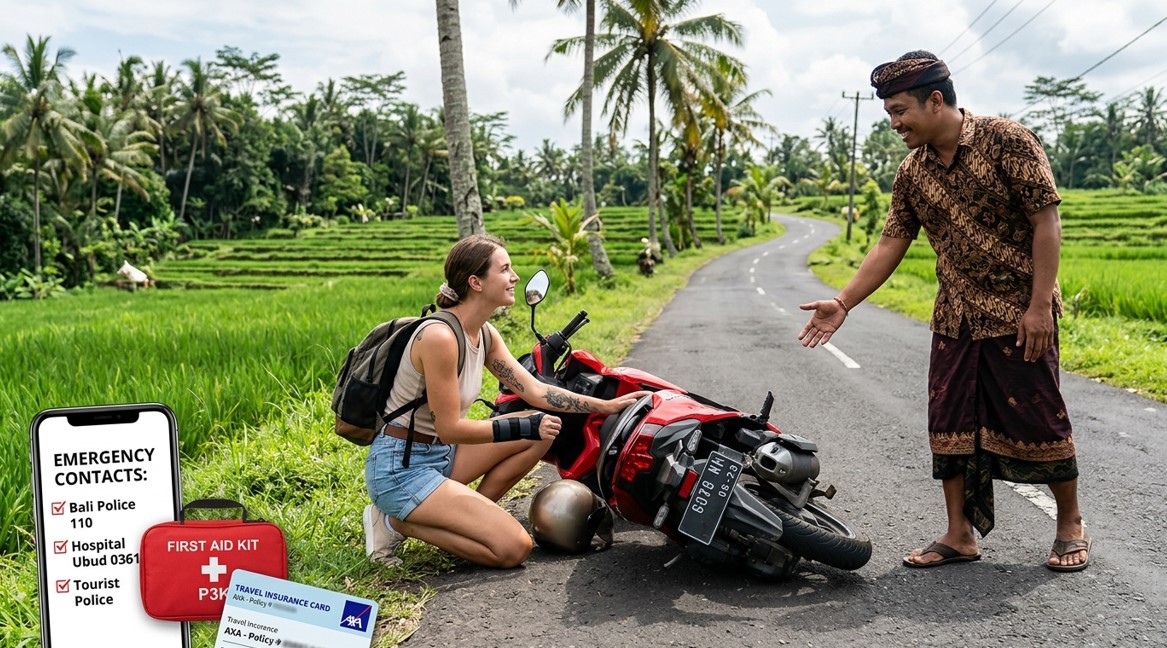 What Should You Do in the First 60 Seconds After a Scooter Accident in Bali?
The immediate priority after any scooter incident is ensuring personal safety and preventing further harm. Move yourself and the vehicle away from active traffic lanes if physically possible, as Bali’s roadways see continuous flow and secondary collisions represent a documented risk. According to 2023 data from the Bali Police Department for Traffic, the island recorded 7,466 road accidents that year, with motorcycles involved in the majority of incidents. Your first action should be activating hazard signals if your scooter remains operational, then positioning yourself in a visible location away from moving traffic.
Assess yourself and any passengers for injuries before addressing vehicle damage. Head trauma, even without visible bleeding, requires immediate medical attention due to the prevalence of delayed symptoms in tropical climates where dehydration can mask concussion indicators. The Canadian government’s travel advisory specifically identifies motorcycle accidents as the primary cause of death and serious injury among foreigners in Indonesia, including Bali. If another party is involved, establish verbal contact to confirm their condition, but avoid discussing fault or accepting blame at this stage, as Indonesian traffic law operates under different liability frameworks than Western jurisdictions.
Secure the scene by taking initial smartphone photographs of vehicle positions before moving them, capturing road conditions, visible damage, and relevant environmental factors such as signage or road markings. These images become critical evidence for insurance claims and potential legal proceedings. Statistics Indonesia reported 269 road fatalities and 76 serious injuries across Bali in 2024, underscoring the seriousness with which authorities and insurance providers treat accident documentation.
How Do You Document the Accident Scene Properly?
Comprehensive documentation begins with a systematic 360-degree video recording of your scooter before moving it from the accident location. This technique captures scratches, dents, and mechanical damage in continuous footage that proves more difficult to dispute than still photographs. Focus your recording on areas rental companies typically scrutinize during return inspections, including the front cowl, mirrors, handlebar ends, exhaust pipe, footpegs, and rear body panels. Time-stamped video evidence has become the standard defense against fraudulent damage claims, a practice that emerged as a countermeasure to what industry observers term “the motorcycle rental damage scam.”
Photograph the broader accident context from multiple angles, ensuring you capture the complete intersection or road segment where the incident occurred. Include images of traffic signals, road surface conditions, weather indicators, and any obstacles or hazards that contributed to the accident. According to protocols outlined by Indonesian legal practitioners, these environmental factors influence fault determination under Indonesian traffic law, particularly in cases involving foreign nationals. Document vehicle registration numbers, visible damage to all involved vehicles, and the exact GPS coordinates if your smartphone supports geotagging.
If another party is involved, exchange contact information including full names, local phone numbers, accommodation addresses, vehicle registration details, and insurance information if available. Photograph their driver’s license and vehicle registration documents rather than relying on handwritten notes, which can become illegible or lost. The thoroughness of this exchange directly impacts your ability to file successful insurance claims or pursue legal recourse if the other party becomes uncooperative during the settlement process.
When Is a Police Report Actually Required for Your Scooter Incident?
Indonesian law mandates police involvement in three specific circumstances: accidents resulting in injury requiring medical treatment, incidents involving significant property damage beyond the vehicles themselves, and collisions where parties cannot reach immediate settlement agreement. The police emergency number throughout Indonesia is 110, though response times vary significantly based on your location within Bali. Tourist areas like Seminyak, Canggu, and Ubud typically see faster response than rural regions.
The official accident report, formally titled “Surat Keterangan Kecelakaan” or “Surat Keterangan Laka Lantas” depending on the issuing district, serves as the foundational document for insurance claims and legal proceedings. This report documents the police’s preliminary determination of circumstances, though it does not assign legal fault. Obtaining this document requires visiting the nearest police station if officers did not attend the scene, bringing your passport, driver’s license, International Driving Permit, rental agreement, and all documentation you collected at the accident site. The report typically takes 24 to 72 hours to process, though this timeline extends during Indonesian public holidays.
Insurance providers universally require police reports for claims exceeding minor cosmetic damage, with most policies defining this threshold between 1,000,000 and 3,000,000 Indonesian Rupiah in repair costs. However, Indonesian cultural practice traditionally favors immediate on-site settlement for minor accidents, a process known locally as resolving matters through “musyawarah” or communal discussion. Liberty International, an organization documenting Balinese legal practices, notes that calling police is considered an action of last resort in Balinese culture, signifying social failure to resolve conflicts through negotiation. Tourists face a practical compromise: respecting local customs while protecting their legal and financial interests through proper documentation.
What Medical Facilities Should You Choose After a Scooter Injury?
Bali’s medical infrastructure operates on a two-tier system: local facilities serving Indonesian residents and international hospitals catering to foreign visitors. BIMC Hospital (Bali International Medical Center) maintains facilities in Kuta, Nusa Dua, and Ubud, representing the gold standard for tourist medical care with English-speaking staff, modern equipment, and direct billing arrangements with major international insurance providers. Emergency room visits at BIMC start at approximately 100 to 250 USD excluding treatment and medication, while doctor consultations range from 40 to 100 USD according to pricing data from Jakarta Herald’s 2025 healthcare cost analysis.
The cost differential between facilities serving locals versus foreigners is substantial and documented. According to Pacific Prime’s research on Bali emergency medical services, foreigners are typically charged 150% more than local rates for identical treatments, with some facilities implementing even higher markups. A broken bone surgery requiring plate insertion ranges from 5,000 to 30,000 USD depending on complexity and facility choice, while head injuries necessitating intensive care can accumulate costs between 30,000 and 80,000 USD according to 2026 insurance industry data. These figures exclude potential medical evacuation, which represents a separate cost category.
Medical evacuation to Singapore, the regional hub for advanced trauma care, costs between 20,000 and 100,000 USD depending on the patient’s condition and required level of in-flight medical support. Generali Global Assistance documented a 180,355 USD medical repatriation from Bangkok to Mexico in 2020, illustrating the extreme upper range of evacuation costs. Research published in Frontiers in Public Health examining economic impacts of medical evacuation in Asia found average direct costs of 12,067 USD, with total costs including indirect expenses reaching approximately 12,975 USD. These statistics underscore why comprehensive travel insurance with specific scooter coverage and adequate medical evacuation limits represents a financial necessity rather than an optional precaution.
For minor injuries not requiring emergency intervention, Trishnanda Care Centre offers on-call doctor services with consultations ranging from 800,000 to 1,500,000 Indonesian Rupiah per visit. This option suits situations where you need professional medical assessment but can avoid hospital emergency department fees. However, any head injury, loss of consciousness, severe bleeding, suspected fractures, or symptoms suggesting internal injury warrant immediate transport to a facility capable of diagnostic imaging and surgical intervention.
How Has Accident Response Protocol in Bali Evolved Over the Past Decade?
A decade ago, scooter accidents in Bali operated almost entirely within an informal settlement ecosystem. Tourists renting vehicles typically received minimal documentation, insurance options were rarely offered or explained, and accident resolution depended heavily on the rental owner’s personal approach and the tourist’s negotiating position. This system functioned when tourism volumes remained manageable and rental operations were predominantly family-run businesses with reputational stakes in their immediate community.
The fundamental flaw in this historical approach was its complete dependence on good-faith negotiation between parties with asymmetric power dynamics. Rental owners held tourists’ passports as collateral, a practice that has since been widely criticized but was nearly universal before 2020. Tourists facing damaged vehicle claims had limited recourse, no standardized damage assessment procedures, and virtually no ability to verify whether claimed repair costs reflected actual market rates. The absence of photographic documentation standards meant disputes over pre-existing damage versus accident-caused damage were resolved through subjective judgment calls that almost invariably favored the party holding the physical asset.
The alternative path that failed to gain traction involved third-party damage assessment services, modeled on Western insurance adjuster systems. Several startups attempted to establish networks of certified mechanics who would provide independent damage valuations for a nominal fee, creating an objective middle ground between tourist and rental owner claims. These services collapsed because they required both parties to agree to binding arbitration, a concept that conflicted with Indonesia’s culturally embedded preference for direct negotiation and mutual agreement. The fundamental assumption behind these failed models was that disputes stemmed from information asymmetry rather than structural power imbalances, misunderstanding the actual dynamics at play.
Modern protocol represents a synthesis that addresses historical vulnerabilities while respecting Indonesian cultural frameworks. Professional rental companies like Balico now offer structured insurance products with clearly defined deductibles, provide comprehensive pre-rental documentation including timestamped photographs, and maintain transparent pricing for common repairs. This evolution was driven primarily by market forces as competition for tourist business intensified and online reviews created reputational accountability that didn’t exist in the pre-digital era. The shift toward documentation-heavy processes emerged not from regulatory intervention but from tourists themselves demanding provable protection after widespread reporting of scam experiences on social media platforms and travel forums.
Does Your Insurance Actually Cover This Scooter Damage?
Insurance coverage for scooter accidents in Bali operates across three distinct layers that frequently confuse tourists: rental company insurance, travel insurance policies, and credit card automatic coverage. Understanding what each layer actually covers requires examining the specific exclusions and limitations that insurance providers carefully embed in policy terms. Most tourists discover these gaps only after an incident, when claims are denied based on technicalities they never anticipated.
Rental company insurance, when offered, typically covers two distinct risks: damage to the rented vehicle and theft of the vehicle. Balico’s insurance structure exemplifies industry standards, offering either partial coverage with a deductible or full coverage without deductible. The critical distinction lies in what these policies explicitly exclude: medical expenses for the rider, damage to third-party property, and injury to third parties. If you crash into another vehicle, damage your rented scooter, and injure yourself in the process, rental insurance addresses only the scooter damage. Your medical bills and liability for the other vehicle fall entirely outside this coverage scope.
Travel insurance policies present a more complex landscape. According to insurance industry analysis, 90% of standard travel insurance policies explicitly exclude scooter and motorcycle coverage unless the policy specifically states otherwise and you purchased the rider endorsement at additional cost. The exclusion mechanism typically operates through engine displacement limits: policies that do cover two-wheeled vehicles often restrict coverage to engines of 50cc or below, while most scooters rented in Bali operate at 110cc to 160cc. A policy from 1Cover New Zealand, documented in social media discussions about Bali coverage, limited moped claims to bikes with engines of 50cc and under, rendering it useless for typical Bali scooter rentals.
The comparison between different insurance approaches reveals fundamental tradeoffs. Purchasing full insurance through the rental company (typically costing 30,000 to 50,000 Indonesian Rupiah per day) eliminates your financial exposure for vehicle damage regardless of fault, but provides zero protection for medical costs or third-party liability. Ради достижения complete vehicle damage protection, you sacrifice breadth of coverage. Conversely, specialty travel insurance with explicit scooter coverage costs significantly more upfront (often 50 to 150 USD for a two-week trip) but covers medical evacuation, hospital treatment, and potentially third-party liability up to policy limits. The основной компромисс of comprehensive scooter-specific travel insurance lies in its higher premium cost versus the low-probability but catastrophic-cost scenario it protects against.
The practical application of this insurance triangulation emerges most clearly in a documented case study: a tourist crashes their scooter in Ubud, sustaining a broken femur and damaging the rental vehicle’s front cowl and mirror. Under rental-only insurance, they pay nothing for the 2,500,000 Rupiah scooter repair but face the full 18,000 USD cost of surgical intervention at BIMC Hospital. Under travel insurance without scooter coverage, they receive no reimbursement for any expense. Under comprehensive coverage with both rental insurance and scooter-specific travel insurance, the rental policy covers vehicle damage while travel insurance covers the medical expenses minus deductible, typically 250 to 500 USD. This specific result demonstrates why experienced travelers to Bali increasingly adopt a layered coverage strategy rather than relying on any single insurance product.
What’s the Real Cost of Skipping Pre-Rental Documentation?
The first critical mistake tourists make is accepting a scooter without conducting a thorough damage inspection documented through video and timestamped photographs. This error stems from understandable business motives: you’ve just arrived in Bali, possibly jet-lagged, eager to begin your vacation, and the rental company staff appears friendly and trustworthy. The social pressure to expedite the handover process and begin exploring feels more immediate than the abstract possibility of a future dispute. However, this seemingly minor time-saving decision exposes you to potential fraud claims upon vehicle return.
When you skip comprehensive pre-rental documentation, the rental company retains unilateral power to identify “new” damage during your rental period. The mechanics of this scam are straightforward: the company photographs existing scratches and dents after you depart, then claims you caused this damage when you return the vehicle. Without your own timestamped evidence proving the damage existed before your rental period, you have no defensive position. The обратная сторона медали of high rental convenience is elevated vulnerability to fraudulent claims, a tradeoff that heavily favors the rental company’s interests over yours.
Calculating the direct financial cost reveals the magnitude of this error. Minor cosmetic damage claims typically range from 500,000 to 2,000,000 Indonesian Rupiah (approximately 30 to 125 USD), amounts small enough that many tourists simply pay rather than engage in prolonged dispute. However, a fabricated claim for a cracked body panel or damaged exhaust can reach 5,000,000 to 10,000,000 Rupiah (310 to 625 USD). The tourist faces a lose-lose decision: pay an inflated claim immediately to catch their departing flight, or remain in Bali for potentially several additional days to dispute the charge while accumulating hotel costs, missing scheduled commitments, and potentially incurring flight change fees that exceed the disputed damage amount.
The second mistake involves renting without verifying the specific terms of the insurance offered. Tourists frequently assume “insurance included” means comprehensive coverage, failing to identify the specific deductible amount or understand which scenarios the policy excludes entirely. This misunderstanding creates catastrophic financial exposure in serious accidents. A crash resulting in 25,000,000 Rupiah (approximately 1,560 USD) in scooter damage, when you assumed you had full coverage but actually have a 10,000,000 Rupiah deductible, leaves you responsible for the first 10,000,000 Rupiah of costs. The цена ошибки of not reading insurance terms before signing is direct financial liability for amounts you believed were covered, compounded by the stress of navigating this discovery while potentially injured or dealing with accident aftermath.
The third critical error is operating a scooter without a valid International Driving Permit in addition to your home country’s motorcycle license. This administrative oversight, motivated by the inconvenience of obtaining an IDP before travel and the perception that enforcement is lax, nullifies your insurance coverage entirely. The Bali.com travel guide explicitly states that both national driver’s license and International Driving Permit are legally required for renting motorized vehicles in Indonesia. When an accident occurs and you file an insurance claim without proper licensing documentation, insurers invoke the policy exclusion for operation without valid credentials and deny the entire claim. The цена ошибки extends beyond the denied claim amount to include potential criminal liability under Indonesian traffic law, which treats unlicensed operation as a separate offense from the accident itself. Medical costs from injuries sustained while unlicensed similarly face claim denial, meaning a severe accident could result in tens of thousands of dollars in uncompensated medical expenses that would have been covered had you invested the 20 to 50 USD and two hours required to obtain an IDP before departure.
The Strongest Argument Against Getting Insurance for Every Scooter Rental
The most compelling case against purchasing comprehensive scooter insurance for Bali rentals rests on statistical probability combined with the actual behavior patterns of experienced long-term visitors. Seasoned digital nomads and extended-stay travelers who rent scooters in Bali for months or years rather than weeks often deliberately skip insurance coverage, operating under a calculated risk framework that makes financial sense within their specific usage context.
Their logic proceeds from this foundation: if you rent a scooter for six months at 1,000,000 Rupiah per month with full insurance adding 30,000 Rupiah per day, the insurance premium alone totals 5,400,000 Rupiah (approximately 337 USD) over that period. For this same amount, you could directly pay for most realistic damage scenarios out of pocket. A dropped scooter with mirror damage and minor scratches typically costs 1,500,000 to 2,500,000 Rupiah to repair. Even a more significant single-vehicle accident causing body panel cracks and handlebar replacement rarely exceeds 8,000,000 Rupiah in actual repair costs at local mechanic rates rather than rental company markup pricing.
The mathematical argument becomes stronger when you consider that careful, experienced riders with thousands of hours of two-wheel experience in Asian traffic conditions have dramatically lower accident rates than first-time scooter tourists. Under these conditions where rider skill is objectively high and accident probability is quantifiably low, insurance represents negative expected value: you pay certain premiums to protect against uncertain losses that your skill level makes genuinely unlikely. For someone who has operated scooters in Bali for three years without incident, the decision to continue paying insurance premiums approaches financial irrationality.
This counterargument holds genuine validity in its specific applicability scenario: highly experienced riders on extended stays in low-complexity riding environments. However, three critical limitations constrain its broader relevance. First, it completely excludes medical cost risk, addressing only vehicle damage. A serious injury requiring medical evacuation costs 20,000 to 100,000 USD regardless of rider experience, and even skilled operators face risks from other drivers’ errors. Second, the argument collapses for short-term tourists whose limited riding experience and unfamiliarity with Balinese traffic patterns place them in demonstrably higher risk categories. Third, it assumes rational risk tolerance that most people don’t actually possess: the psychological stress of riding uninsured, knowing a single mistake could cost thousands of dollars, often outweighs the mathematical expected value calculation for risk-averse individuals.
Despite these limitations, the core insight remains valid: insurance is not universally optimal for every individual in every circumstance. The основной тезис of this article—that proper preparation and documentation are essential for tourists renting scooters in Bali—holds true for the vast majority of visitors, who are precisely the population for whom insurance represents rational risk management. But acknowledging the existence of a specific subset for whom self-insurance makes mathematical sense strengthens rather than weakens the overall guidance by demonstrating sophisticated understanding of when rules apply versus when exceptions are justified.
How Do You Navigate the Settlement Process With Your Rental Company?
Upon returning your damaged scooter, the settlement process begins with the rental company’s damage assessment. Professional operations follow standardized procedures: a staff member conducts a visual inspection, comparing the vehicle’s current condition against the pre-rental documentation you both signed. The existence of your own comprehensive photographs and video from pickup becomes critical leverage at this stage. When the rental representative identifies damage, immediately cross-reference their claim against your pre-rental documentation. If the damage appears in your pickup video, you have irrefutable evidence it preceded your rental period.
For legitimate damage you caused, the negotiation centers on repair cost valuation. Rental companies typically present repair estimates from their affiliated mechanics, which often include markup above market rates. Request an itemized breakdown specifying each damaged component and associated repair cost. Research typical prices for these repairs at independent Bali mechanics through online forums or by physically visiting nearby repair shops with photos of the damage. This comparative data provides negotiating leverage: if the rental company claims 3,000,000 Rupiah for a mirror replacement that independent shops price at 800,000 Rupiah, you have objective grounds to dispute the inflated charge.
Indonesian business culture, particularly in Bali’s tourism sector, expects negotiation. Rental representatives often quote initial damage assessments 30% to 50% above their actual settlement expectations, anticipating you will negotiate downward. Approach this process with calm professionalism, presenting your documentation and pricing research while acknowledging the legitimate damage. A reasonable settlement typically lands within 10% to 20% above independent mechanic pricing, accounting for the rental company’s administrative overhead and the convenience of resolving the matter immediately rather than through extended dispute processes.
If you cannot reach acceptable settlement terms, you have three escalation options. First, request involvement from your rental company’s management rather than frontline staff, as managers have broader authority to approve settlements outside standard pricing. Second, engage your insurance provider if you purchased coverage, providing them with all documentation and allowing them to negotiate directly with the rental company. Third, in cases of clear fraudulent claims, document everything and report the incident to tourist police while posting detailed reviews on platforms like Google Maps and TripAdvisor, creating reputational consequences that often motivate companies to settle reasonably rather than risk public exposure.
The timeline for settlement affects your leverage significantly. If you have flexible travel plans and can remain in Bali for several additional days, you occupy a stronger negotiating position than if you must catch a departing flight within hours. Rental companies are aware of this dynamic and sometimes deliberately delay assessment for tourists they know are time-constrained. Counter this tactic by returning the scooter at least 24 hours before your departure, giving yourself buffer time for documentation, negotiation, and potential escalation without missing travel connectiс.

Would you like to comment?