
Renting a Car in Bali with Kids: Child Seats, Best Car Types, and What to Ask Before Booking
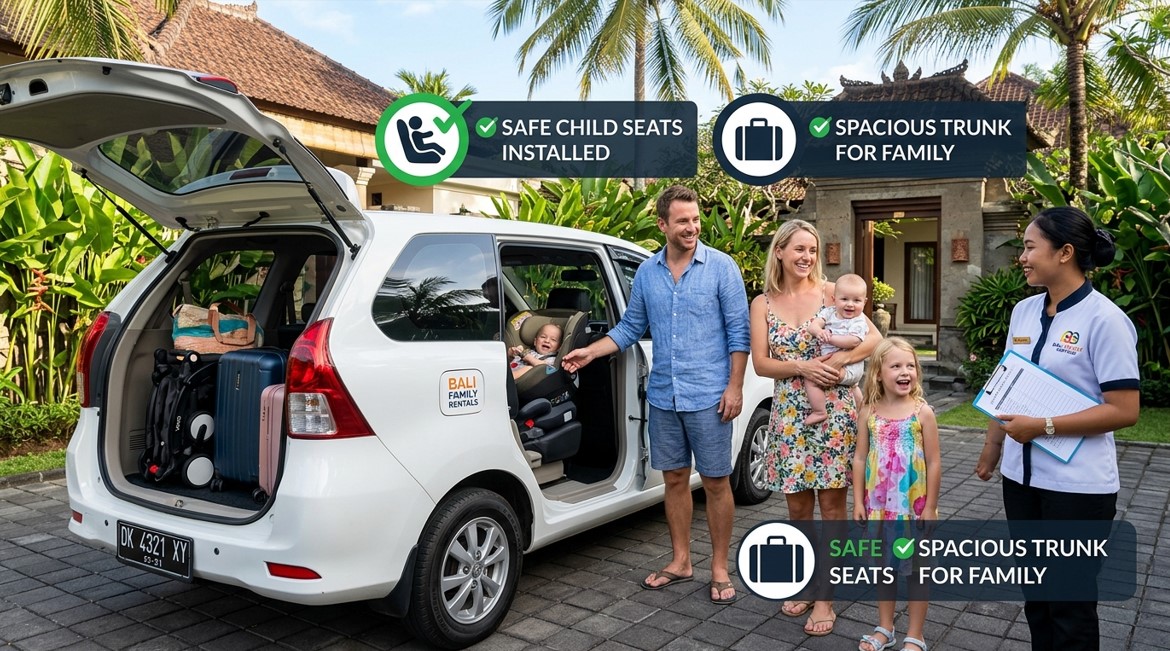 Renting a car in Bali with children involves navigating a regulatory landscape where formal requirements exist but practical enforcement remains inconsistent. Indonesian Law No. 22 of 2009 on Traffic and Road Transport mandates that children under 12 years must use age-appropriate child restraints in private and rental vehicles, yet the majority of local cars lack proper ISOFIX anchor points, and roadside enforcement is virtually non-existent. This disconnect creates a situation where families must make informed decisions based on actual vehicle specifications, seat availability quality, and the statistical reality that road traffic injuries account for 20% of deaths among children and adolescents under 20 in Indonesia, according to UNICEF’s 2023 Road Safety Strategy report.
What Are the Current Child Car Seat Laws in Bali and Indonesia?
Indonesia technically requires children under 12 years to use appropriate child restraint systems, with specific categories defined by age. Infants aged 0-1 year must use rear-facing infant seats, toddlers aged 1-4 years require forward-facing seats with harnesses, and children aged 4-12 years need booster seats or restraints suitable for their height and weight. However, this legal framework exists primarily on paper. The traffic police in Bali do not actively enforce child restraint use, and penalties for non-compliance are rarely issued. This creates a situation where the decision to use car seats becomes a personal risk calculation rather than a legal obligation.
Does Indonesian Law Actually Require Car Seats for Children Under 12?
The legal requirement exists in the 2009 Traffic Law, but the implementing regulations lack specificity. The law does not define acceptable restraint standards, provide certification requirements for car seats, or establish inspection protocols for rental vehicles. This ambiguity means rental companies operate without clear compliance benchmarks. The practical result is that while the law theoretically requires restraints for children under 12, there is no standardized enforcement mechanism, no vehicle inspection requirement for anchor point functionality, and no mandatory training for rental staff on proper installation techniques.
What’s the Real Enforcement Situation on Bali Roads in 2026?
Traffic enforcement in Bali focuses almost exclusively on helmet violations for motorcyclists and occasional red-light infractions. Child restraint use in cars is not checked during routine traffic stops, nor is it part of vehicle rental inspection procedures. Multiple expat family forums from early 2026 confirm that families traveling without car seats report zero enforcement encounters over multi-week stays. This doesn’t negate the safety imperative, but it does explain why the majority of rental vehicles are not equipped with properly functioning anchor systems.
| Criterion | 🚐 Minivan (Xpander / Avanza / Ertiga) | 🚙 Mid-size SUV (CR-V / Pajero Sport / Fortuner) |
|---|---|---|
| Daily rental cost | 💰 IDR 250,000 – 300,000 Dominant choice in the family segment thanks to the optimal balance of price and cabin capacity. |
💰 From IDR 500,000 At least 1.7–2× more expensive than a minivan; premium models like the Fortuner can reach IDR 700,000+ per day. |
| Fuel consumption | ✅ 7–8 L / 100 km 1.5L engine is economical on daily transfers between locations; saves up to IDR 35,000 per 100 km. |
⚠️ 12–14 L / 100 km Larger engine and weight nearly double fuel use; over a 14-day rental the gap reaches IDR 1.5–2M. |
| Engine and power | ⚠️ 1.5L, ~105 hp Overtaking on mountain switchbacks is slow and requires planning the trajectory in advance. |
✅ 2.0L+, all-wheel drive Confident dynamics on any terrain; reserve torque for overtaking on the Denpasar–Gilimanuk highway. |
| Ground clearance | ⚠️ 170–180 mm Sufficient for most paved routes, but risky on dirt roads after rain. |
✅ 200–220 mm Confidently handles dirt approaches to Sekumpul and Munduk waterfalls and mountain temples in any weather. |
| Cabin configuration | ✅ 3 rows of seats Two child seats fit in row 2 while preserving access to row 3 for an adult or older child. |
⏱️ 2 rows (5 seats) or 3 rows Depends on the model — CR-V offers 5 seats, Pajero Sport and Fortuner 7 with less convenient access. |
| Boot capacity | ⏱️ 100–150 L (3rd row up) / 550–650 L (folded) Enough for two strollers and family luggage when the third row is folded. |
✅ 500–700+ L in standard configuration Large boot without sacrificing seating capacity. |
| Maneuverability in Ubud / Canggu | ✅ Turning circle ~5.2–5.5 m Parking near warungs and on narrow streets requires only one or two attempts. |
⚠️ Turning circle 5.8–6.2 m Narrow streets often require a three-point turn; parking spaces are frequently too tight. |
| Serpentines and mountains | ⚠️ Routes like Ubud–Amed or Seminyak–Lovina are demanding: 600 m elevation changes and 15 m radius corners stress the engine. | ✅ AWD and reserve power make mountain routes comfortable; stable torque reduces motion sickness in children. |
| ISOFIX availability | ⚠️ Depends on model year — pre-2019 Avanza may lack ISOFIX. Xpander and Ertiga from 2020 onward come with anchors as standard. | ✅ In 2018+ Japanese SUVs ISOFIX is factory-equipped; anchors on both outer seats of row 2. |
| Rear-passenger climate control | ✅ Dedicated vents for rows 2 and 3 in most models; critical at 32°C and 80% humidity in coastal areas. | ✅ Full dual or triple-zone climate system; the child in the seat receives a direct flow of cool air. |
| 14-day budget (with fuel) | 💰 ~IDR 5.5–6.5M Rental + fuel + parking fits within an average family budget. |
💰 ~IDR 9–11M The two-week gap with the minivan is roughly USD 90–110, plus the increased fuel consumption. |
| Main risks | Weak dynamics on long climbs at full load; low clearance on dirt approaches after heavy rain; need to fold the third row when carrying two strollers. | Significant budget overrun when the off-road capability is underutilized; parking difficulty in historic areas of Ubud; larger turning radius on Canggu’s narrow lanes. |
| Best suited for | Families with 2+ children and standard paved routes (Canggu, Seminyak, central Ubud, Sanur); priority on capacity and fuel economy over off-road capability. | Families planning trips to remote waterfalls and mountain temples; travel during the rainy season (November–March) with dirt approaches; priority on safety and dynamics over budget. |
Which Type of Child Restraint Does Your Child Actually Need?
Child restraint selection must match three critical parameters: the child’s weight, height, and developmental stage. Rear-facing infant capsules are designed for newborns up to approximately 12 months or 10 kilograms, providing crucial neck and spinal support during sudden deceleration. Convertible car seats serve children from roughly 6 months to 4 years, transitioning from rear-facing to forward-facing configurations as the child grows. Booster seats elevate children aged 4-8 years so that standard seat belts cross their chest and lap at anatomically correct positions, preventing abdominal injuries in collisions. The challenge in Bali is not identifying which seat your child needs theoretically, but whether the rental vehicle can physically accommodate that seat type with secure attachment.
How Do Age-Based Car Seat Categories Work in Indonesia?
Indonesian child restraint recommendations follow international best practices in theory, but the equipment available locally often predates current safety standards. Rental car seats in Bali frequently lack manufacture date labels, making it impossible to verify whether they exceed the standard six-year lifespan before materials degrade. Many seats offered by budget rental companies are Chinese-manufactured units without European ECE R44/04 or R129 (i-Size) certification. This means even if you book a car seat in advance, you may receive a restraint that wouldn’t pass safety inspection in Australia, the EU, or North America. The age categories themselves are universal, but the equipment quality varies dramatically between premium rental services that import certified seats and local operators using whatever is cheapest.
Why ISOFIX Anchor Points Matter (and Why Most Bali Cars Don’t Have Them)
ISOFIX (also called LATCH in the US) is a standardized anchoring system using rigid metal connectors between the car seat and vehicle frame, eliminating installation error and providing superior crash protection compared to seat belt installation. The system requires specific anchor bars embedded in the vehicle seat structure, typically between the seat cushion and backrest. The fundamental problem is that Indonesia’s domestic automotive market historically prioritized low manufacturing costs, and ISOFIX installation adds expense. Consequently, the Toyota Avanza models manufactured before 2022 that dominate Bali’s rental fleet lack ISOFIX points entirely. Even the newer Innova models may have anchor points only in the center rear seat, not the outboard positions. This means families arriving with ISOFIX-compatible car seats from home often discover they must use less secure seat belt installation, which reduces the seat’s protective capability by an estimated 30% in frontal collisions according to crash test data from the Insurance Institute for Highway Safety.
Evolutionary Path: How Bali Families Transported Children Before 2020
A decade ago, expatriate families in Bali faced a binary choice for child transportation: hire full-time drivers with Toyota Innova vehicles and hope the driver maintained reasonable speeds, or accept that children would ride unrestrained on short trips. Car seat availability was essentially zero through rental companies. Families who prioritized safety either shipped car seats from their home countries at considerable expense or purchased seats from Jakarta baby stores during mainland trips. The default practice for most families was lap-holding for infants during short journeys and allowing older children to sit unrestrained on regular seats, operating under the assumption that Bali’s congested traffic kept speeds low enough to minimize risk.
What Solutions Did Expat Families Use 10-15 Years Ago?
Before specialized baby equipment rental services emerged around 2018-2019, families relied on improvised solutions. Some brought inflatable booster cushions that could pack flat in luggage but provided minimal side-impact protection. Others used the “taxi trade-off” method, where they accepted higher per-trip costs to hire specific drivers known to have vehicles with functioning rear seat belts. A small subset of families purchased inexpensive car seats upon arrival and resold them in expat Facebook groups before departure. The most telling indicator of how inadequate these solutions were is that multiple parenting forums from that era contain threads where families openly discussed simply skipping car seats entirely for their Bali stays, rationalizing the decision by comparing traffic speeds to school parking lots at home.
Why the “Lap-Holding” Practice Still Persists
Despite documented risks, lap-holding infants during car travel remains common in Bali for three interconnected reasons. First, the majority of local Indonesian families do not use car seats, creating a social norm where the practice appears acceptable. Second, ride-hailing services like Grab and Gojek do not provide or require car seats, and their vehicles often lack rear seat belts entirely. Third, there’s a persistent misconception that low-speed travel negates the need for restraints. Physics contradicts this assumption. A collision at just 30 kilometers per hour generates forces that make it impossible for an adult to maintain grip on a child. The infant becomes a projectile. This practice persists not because it’s safe, but because it’s normalized, convenient, and rarely results in immediate visible consequences until the statistical probability catches up with a specific family.
Should You Bring Your Own Car Seat or Rent One in Bali?
The decision involves comparing the known quality of your home car seat against the uncertain condition of Bali rental seats, while factoring in airline fees and logistical hassle. If you bring your own seat, you guarantee its crash history, manufacturing date, and compatibility with your child’s specific dimensions. However, you absorb airline gate-check fees (typically 50-100 USD round trip for international carriers), risk damage during baggage handling, and still face the possibility that the rental vehicle lacks proper anchor points. Renting locally through premium services like Bali Baby Hire costs approximately 35 USD for an entire rental period and delivers the seat to your accommodation, but you cannot verify the seat’s history or whether it has been in a previous collision that compromised its structural integrity.
What’s the True Condition of Rental Car Seats in Bali?
Rental car seat quality in Bali operates on a three-tier system. Premium dedicated baby equipment rental companies import Australian or European certified seats, maintain service records, and retire seats after expiration dates or any reported collision involvement. These services represent roughly 15% of available options and charge accordingly. Mid-tier car rental companies offer car seats as add-ons, typically Chinese-manufactured units without verifiable certification, maintained inconsistently, and used until physical breakage rather than expiration date. Budget operators often provide car seats that are visibly sun-damaged from storage in hot vehicles, have frayed harness straps, or lack the original installation manuals making proper setup nearly impossible. The concerning reality is that you usually cannot inspect the actual seat until vehicle delivery, at which point you’re already committed to the rental and potentially rushing to reach an airport or attraction.
How Do You Calculate the Break-Even Point for Bringing Your Own Seat?
The financial calculation must include both direct costs and risk-adjusted value. If your airline charges 75 USD round trip to gate-check a car seat, and local rental costs 35 USD, the apparent savings is 40 USD by renting. However, if the rental seat lacks certification and has unknown crash history, you’re accepting increased injury risk during your trip. The monetized value of that risk depends on your personal risk tolerance, but insurance actuaries typically price child passenger injury risk in rental vehicles at several thousand dollars of expected cost per trip when restraints are absent or substandard. Conversely, bringing your own seat only makes financial sense if you can verify in advance that your rental vehicle has compatible anchor points. Shipping a seat internationally that then cannot be installed securely delivers the worst outcome: you paid extra fees and still lack proper protection. The recommendation for families with children under 4 is to bring your own seat if you’ve confirmed ISOFIX compatibility with the rental company in writing, or to book premium local rental services that can provide photographic proof of seat condition and certification before your arrival.
Which Vehicle Type Actually Works Best for Families with Kids?
Vehicle selection for family travel with children prioritizes three functional requirements: sufficient rear seat width to accommodate car seats without excessive crowding, adequate climate control to prevent heat stress during tropical midday travel, and trunk capacity that still allows luggage storage after car seat installation reduces usable space. The most common rental vehicles in Bali are the Toyota Avanza and Toyota Innova, both multi-purpose vehicles (MPVs) designed for Asian markets. The critical differences for families are not the features highlighted in rental marketing, but rather the interior dimensions and seat configuration that determine whether two car seats can be installed side-by-side or whether older children will be cramped during longer journeys to Ubud or Uluwatu.
Toyota Avanza vs. Innova: The Real Differences That Matter for Child Safety
The Toyota Avanza features a 1.3L or 1.5L engine and seats six to seven passengers in three rows, but its rear seat width measures only 138 centimeters across. This means installing two car seats side-by-side in the second row creates significant squeeze, and the third-row seats are genuinely only suitable for children under 10 due to limited legroom. The Avanza’s cargo space reduces to approximately two medium suitcases once the third row is occupied. The Toyota Innova uses a larger 2.0L engine and provides 148 centimeters of second-row width, allowing two car seats with a center seating position still accessible for an older child. The Innova’s second-row seats also sit approximately 5 centimeters higher, improving adult sightlines when supervising children and making it easier to reach across to adjust harnesses or provide snacks during travel. The cost difference averages 10-15 USD per day, but for families with two children requiring car seats, the Innova eliminates the daily frustration of cramped installation and provides noticeably better climate control airflow to rear passengers.
Why Cabin Space Matters More Than Engine Power for Family Travel
Rental marketing emphasizes engine specifications and fuel economy, but the primary stressor for family travel in Bali is interior comfort during congested traffic, not highway performance. Bali’s main tourist routes between Seminyak, Ubud, Canggu, and Uluwatu involve frequent stops, slow-moving traffic during peak hours, and extended periods where children are restrained and potentially uncomfortable in tropical heat. A vehicle with an extra 10 centimeters of rear seat width allows children to avoid touching shoulders, reduces sensory overload, and provides space for a parent to sit between car seats to provide comfort during fussy periods. This interior space consideration becomes acute when families attempt to travel during midday heat. Vehicles with insufficient cabin volume and weak rear air conditioning create conditions where children overheat, become distressed, and make the journey unsafe because parents are tempted to remove layers or loosen harnesses to cool the child down, which compromises restraint effectiveness.
The Three Most Expensive Mistakes When Renting a Car with Kids in Bali
The first critical error is booking a car rental without confirming anchor point availability and then discovering upon vehicle delivery that your car seat cannot be installed securely. Families who make this mistake either proceed with dangerous lap-belt-only installation that fails in collisions, or they scramble to rent replacement seats locally at premium rates from hotel concierges who charge 2-3 times the market rate. The direct cost of this mistake is 100-150 USD in emergency seat rental fees, plus the risk cost of traveling with improperly installed restraints during the search period. The second mistake is accepting the cheapest available car seat add-on without verifying its certification, condition, or expiration status. Rental companies that offer car seats for 5 USD per day are providing seats that cost them approximately 30-40 USD to purchase wholesale, meaning they are bottom-tier quality, likely lack side-impact protection, and have unknown service history. The false economy appears to save 30 USD over a week compared to premium rental services, but delivers equipment that may fail its primary protective function during a collision. The third mistake is inadequate insurance coverage specifically for child passenger medical costs. Standard rental car insurance in Bali typically includes third-party liability and collision damage waiver, but personal accident coverage for passengers is often an optional add-on costing 3-5 USD per day. Families who decline this coverage to save 35 USD on a week rental expose themselves to potential out-of-pocket medical costs exceeding 10,000 USD if a child requires emergency hospitalization or medical evacuation following a traffic accident.
What You Must Ask the Rental Company Before Confirming Your Booking
Your pre-booking inquiry must extract specific technical confirmations, not the generic reassurances that rental agents provide to close sales. The essential questions operate as a filtering mechanism that identifies whether the rental company actually understands child passenger safety or is simply willing to say whatever is necessary to secure your reservation. Start by requesting the exact vehicle make, model, and manufacturing year you will receive, not just the category. Then ask specifically whether that vehicle has ISOFIX anchor points, in which seating positions they are located, and whether the company can provide photographic documentation showing the anchor point locations. This question alone eliminates roughly 60% of Bali rental operators who cannot answer with specificity.
How Do You Verify the Car Has Proper Seat Belt Anchor Points?
Proper seat belt anchor points for car seat installation require a three-point belt system with a locking retractor or a locking clip. Many older vehicles in Bali’s rental fleet have rear seat belts that are lap-only in the outboard positions, or feature belts that do not lock when pulled fully extended, making them unsuitable for securing car seats under tension. The verification process requires asking the rental company whether the rear seat belts are three-point harnesses and whether they feature automatic locking retractors (ALR) or emergency locking retractors (ELR). If the agent cannot answer this question, request to inspect the vehicle before finalizing the rental. During inspection, pull the seat belt fully extended. An ALR belt will lock and prevent further extraction, confirming it can secure a car seat. An ELR belt will allow slack, requiring a locking clip to maintain tension. If the rental company cannot provide locking clips and the vehicle lacks ALR belts, the car seat installation will be compromised regardless of how tightly you pull the belt initially, because normal driving forces will gradually loosen the installation over hours of travel.
What Insurance Actually Covers Child Passengers in an Accident?
Standard rental car insurance structures in Bali include Collision Damage Waiver (CDW), which covers damage to the rental vehicle itself, and Third-Party Liability (TPL), which covers damage and injury to other people outside your vehicle. Neither of these policies covers medical costs for passengers inside your rental vehicle. Child passenger medical coverage requires Personal Accident Insurance (PAI), an optional add-on that typically costs 3-5 USD per day and provides 5,000-10,000 USD of medical expense coverage per passenger. The specific question to ask is whether the PAI policy covers all passengers including children, what the per-person coverage limit is, and whether it includes medical evacuation. Some budget rental companies offer PAI with sub-limits for children under 12, or exclude coverage entirely for passengers under 5 years old. Families who assume their travel health insurance covers rental car accidents often discover their policies contain specific exclusions for incidents occurring in vehicles they are renting rather than riding as commercial passengers.
The Strongest Argument Against Using Car Seats in Bali (And Why It’s Wrong)
The most frequently articulated counter-argument is that Bali’s congested traffic keeps average speeds below 30 kilometers per hour in tourist areas, making the injury forces from typical collisions lower than those on highways in Western countries. Proponents of this view, common in expat forums, point out that Indonesian families universally do not use car seats, yet families continue to travel without mass casualty incidents, suggesting that the risk is overstated for local conditions. This argument contains a kernel of truth wrapped in a dangerous fallacy. Average speeds in Seminyak and Canggu during peak hours genuinely do hover around 20-30 kilometers per hour, which reduces collision energy compared to 100-kilometer-per-hour highway impacts. However, this average conceals two critical realities. First, travel between tourist areas requires road segments like the Sunset Road corridor and the bypass roads where traffic regularly reaches 60-80 kilometers per hour. Second, and more importantly, collisions in congested traffic frequently involve motorcycles, which comprise over 65% of Bali’s registered vehicles. Motorcycle impacts occur from side angles and create rotational forces that unrestrained children are particularly vulnerable to. The injury mechanism is not always frontal deceleration, but lateral impacts and rollovers where children become projectiles inside the cabin. The statistical evidence contradicts the low-speed safety assumption. UNICEF’s 2023 data shows that road traffic injuries cause 20% of deaths among children and adolescents under 20 in Indonesia, a rate higher than in countries with faster average speeds but higher restraint usage. The correlation suggests that collision speed is not the primary variable, restraint use is.

Would you like to comment?