
Parking, Fuel, and Fines in Bali: The Everyday Costs Tourists Often Forget
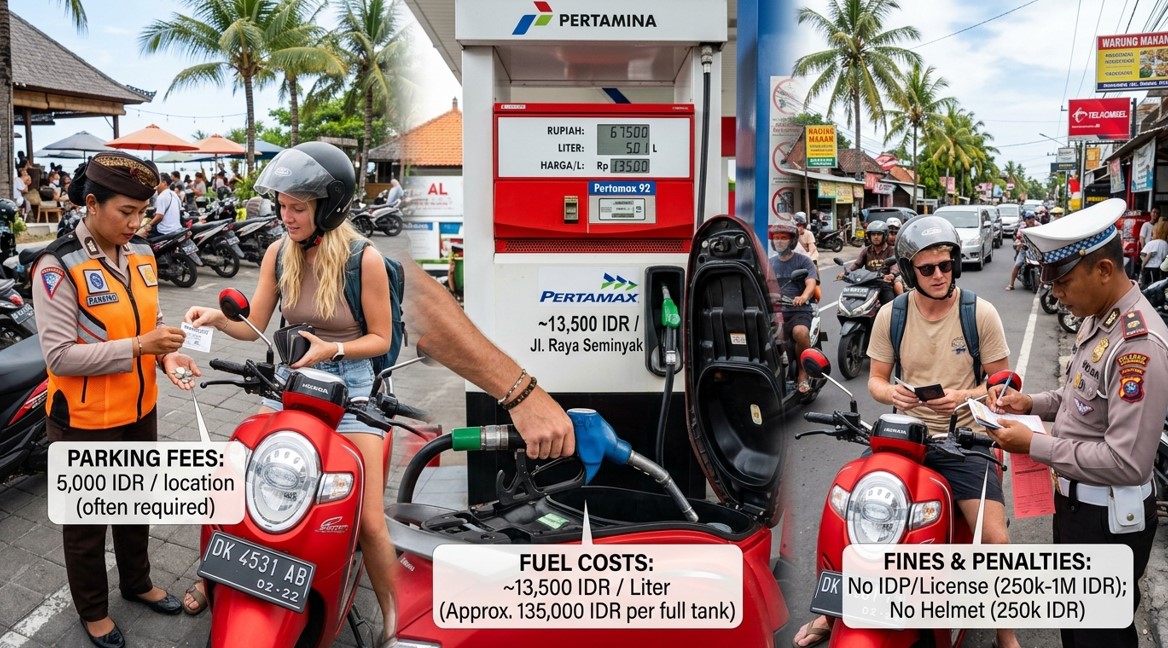 Most travelers meticulously budget for flights, accommodations, and tours when planning a Bali trip, yet consistently underestimate the cumulative impact of daily operational expenses. Parking fees, fuel consumption, and traffic violations constitute a shadow budget that can inflate actual spending by 15 to 25 percent over a two-week stay. These costs are neither trivial nor predictable, varying dramatically between tourist-heavy zones and residential neighborhoods, and they operate through systems unfamiliar to most foreign visitors.
What Are the Real Parking Costs Tourists Face in Bali?
Parking in Bali costs between IDR 2,000 and IDR 20,000 per instance for scooters, depending on location type and duration. Beach clubs, premium dining establishments, and popular tourist attractions in Seminyak and Canggu typically charge IDR 5,000 to IDR 10,000 per scooter, while temple sites and waterfalls may demand IDR 10,000 to IDR 20,000 as combined entry and parking fees. A tourist visiting three to four destinations daily accumulates IDR 20,000 to IDR 40,000 in parking costs alone, translating to IDR 280,000 to IDR 560,000 weekly, or approximately $18 to $36 USD at current exchange rates.
The financial drain intensifies for car renters. Ngurah Rai International Airport parking fees exemplify premium pricing structures: the first hour costs IDR 12,000, with progressive charges of IDR 3,000 per subsequent hour for cars. Multi-day parking at high-traffic attractions like Tegallalang Rice Terraces or Tanah Lot compounds these expenses significantly. Data from Bali’s Tourism Board indicates that tourists driving cars spend 40 percent more on parking than scooter users across equivalent itineraries.
How Does Bali’s Informal Parking Attendant System Work?
The tukang parkir system operates as Bali’s decentralized parking infrastructure, employing thousands of informal attendants who manage roadside and private lot parking. These attendants receive no government salary, instead deriving income directly from motorists at rates they determine situationally. Standard fees hover around IDR 2,000 for scooters in residential areas, but tourist-dense locations see attendants requesting IDR 5,000 to IDR 10,000 without providing official tickets or receipts.
This system creates asymmetric information disadvantages for tourists. Unlike formal parking with ticketed validation, tukang parkir transactions rely on cash payments to individuals wearing no standardized uniforms or identification. Some establishments post signage declaring “Parking Free” specifically to combat unauthorized attendants who position themselves at entrances despite having no legitimate authority. The absence of receipts means no recourse exists if disputes arise over payment amounts or vehicle damage claims.
The economic compromise inherent to this system delivers flexible, ubiquitous parking availability throughout the island, particularly in areas where formal infrastructure development lags behind tourism growth. However, tourists sacrifice payment transparency and standardized pricing, creating unpredictable daily expenditures that compound over extended stays. Experienced travelers report that firmly but respectfully stating “sudah bayar” (already paid) when encountering duplicate payment requests at single locations effectively navigates this terrain without confrontation.
Where Do Parking Costs Add Up Fastest for Tourists?
Beach clubs along Seminyak’s coastline impose the steepest parking premiums in Bali, with establishments like Potato Head and Finn’s Beach Club charging IDR 10,000 to IDR 20,000 for scooter parking as part of venue access fees. These charges often appear as line items on final bills alongside the 10 percent government tax and 5 to 10 percent service charges that Indonesian hospitality venues are legally permitted to collect. A single afternoon at two beach clubs therefore generates IDR 20,000 to IDR 40,000 in parking costs before considering any food or beverage expenditure.
Sacred sites present another cost concentration point. Temples like Uluwatu and Tanah Lot bundle parking into entrance packages ranging from IDR 30,000 to IDR 60,000 per person for foreign visitors, with vehicle parking already embedded in these fees. Conversely, waterfall destinations in central Bali frequently separate entrance fees (IDR 15,000 to IDR 20,000) from parking charges (IDR 5,000 to IDR 10,000), creating stacked payment points that tourists encounter sequentially rather than as consolidated pricing.
Shopping mall parking in Denpasar operates on time-based automated systems, with three-hour free periods followed by IDR 3,000 hourly increments. Extended shopping sessions or multi-venue mall visits can generate surprising parking bills. The automated ticketing removes negotiation ambiguity but introduces time-pressure dynamics absent from flat-fee informal parking arrangements.
How Much Do Tourists Actually Spend on Fuel in Bali?
Tourists renting scooters in Bali spend IDR 50,000 to IDR 100,000 weekly on fuel for moderate daily usage patterns of 30 to 50 kilometers. As of April 2026, Pertamax fuel costs IDR 12,300 per liter in Bali and Java regions, with Pertalite priced at IDR 10,000 per liter for subsidized access. Most rental scooters feature 5 to 7-liter fuel tanks and achieve approximately 30 to 40 kilometers per liter under normal riding conditions, meaning a full tank delivers 150 to 280 kilometers of range depending on engine efficiency and riding behavior.
Daily fuel consumption calculations reveal the practical economics. A tourist riding from Seminyak to Ubud (30 kilometers one way) consumes approximately 1.5 to 2 liters roundtrip, costing IDR 18,450 to IDR 24,600 with Pertamax. Multiply this across five excursion days weekly, and fuel expenses reach IDR 92,250 to IDR 123,000 before accounting for local neighborhood travel. Extended trips to northern Bali destinations like Lovina or Amed from southern tourist centers can consume 4 to 5 liters one-way, representing significant single-day fuel budgets of IDR 49,200 to IDR 61,500.
Fuel costs scale non-linearly with ambition. Tourists attempting comprehensive island exploration covering Uluwatu, Ubud, Sidemen, and Amed within one week easily surpass 300 to 400 total kilometers, demanding IDR 150,000 to IDR 200,000 in fuel expenditure. These figures exclude the parking fees accumulated at each destination, creating compounding transportation costs that many travelers fail to anticipate during initial budgeting phases.
Which Fuel Type Should You Use to Avoid Engine Damage?
Pertamax (RON 92) represents the optimal fuel choice for rental scooters in Bali to prevent carbon buildup and maintain engine performance throughout rental periods. While Pertalite (RON 90) costs 18.7 percent less at IDR 10,000 per liter, this subsidized fuel grade contains lower octane ratings designed for older engine technologies. Modern automatic scooters prevalent in Bali’s rental fleet, particularly Honda Vario and Yamaha NMAX models, specify Pertamax or equivalent RON 91+ fuels in their manufacturer guidelines.
The engineering compromise becomes evident through long-term performance degradation. Pertalite usage in engines calibrated for higher octane ratings creates incomplete combustion, depositing carbon residue on spark plugs and valves over time. Rental companies operating multi-year scooter fleets report that consistent Pertalite use reduces engine lifespan by 20 to 30 percent compared to Pertamax-fueled equivalents. While individual tourists won’t observe catastrophic failure during week-long rentals, the marginal cost savings of IDR 2,300 per liter provide false economy when considered against potential deposit forfeitures for mechanical issues.
Fuel quality directly impacts consumption efficiency. Field tests conducted by Indonesian automotive forums demonstrate that scooters running Pertamax achieve 8 to 12 percent better kilometers-per-liter rates than identical models using Pertalite, partially offsetting the price differential. A scooter achieving 38 kilometers per liter on Pertamax versus 34 kilometers per liter on Pertalite requires 7.9 liters versus 8.8 liters for 300 kilometers of travel. At respective fuel prices, this totals IDR 97,170 for Pertamax against IDR 88,000 for Pertalite, yielding actual savings of only IDR 9,170 (approximately $0.60 USD) while accepting accelerated engine wear.
Why Do Rental Scooters Consume More Fuel Than Expected?
Rental scooters in Bali deliver 15 to 25 percent lower fuel efficiency than advertised manufacturer specifications due to maintenance deferrals, tire pressure inadequacies, and riding behavior patterns specific to inexperienced tourist operators. Manufacturers rate Honda Vario models at 40 to 45 kilometers per liter under optimal conditions, yet tourists consistently report 30 to 35 kilometers per liter in real-world Bali usage, creating budgetary discrepancies when planning fuel costs.
Mechanical factors dominate this efficiency gap. Rental fleet scooters accumulate 10,000 to 20,000 kilometers annually across multiple short-term users, with maintenance schedules frequently stretched beyond manufacturer recommendations. Under-inflated tires, common in rental units that receive sporadic pressure checks, increase rolling resistance by 10 to 15 percent. Worn drive belts in automatic transmission systems create power transfer inefficiencies that force engines to work harder for equivalent speeds. Air filter contamination from Bali’s dusty roads restricts airflow, richening fuel mixtures beyond optimal combustion ratios.
Operator behavior compounds these mechanical inefficiencies significantly. Tourists unfamiliar with scooter dynamics frequently accelerate aggressively from stops, climb hills in incorrect gear ranges, and maintain unnecessarily high speeds on short connecting roads between destinations. Each aggressive acceleration from 0 to 40 km/h consumes fuel equivalent to several minutes of steady cruising. Research from Indonesian transportation studies indicates that smooth, anticipatory riding techniques improve fuel economy by 20 to 30 percent compared to reactive, aggressive patterns typical of novice riders navigating unfamiliar routes.
The cargo factor introduces additional parasitic losses. Tourists carrying backpacks, shopping bags, or traveling two-up with luggage increase vehicle weight by 15 to 30 kilograms beyond solo riding. Physics dictates that moving additional mass requires proportionally more energy, degrading fuel economy by 5 to 10 percent on level roads and up to 15 percent on Bali’s mountainous interior routes between Ubud and coastal regions.
| Criterion | 🛡️ Full compliance (IDP + Pertamina + paid parking) | 💸 Cutting corners at any cost (no IDP + roadside fuel + free parking) |
|---|---|---|
| Rental documentation | ✅ IDP category A + STNK from rental + insurance policy Full set ready for police checks; protection against vehicle impoundment. |
⚠️ Passport only, no STNK verification Rental from an unverified operator at IDR 100,000–150,000 below market rate. |
| Monthly rental cost | 💰 IDR 800,000 (market standard) Transparent price including documents and basic insurance. |
💰 IDR 650,000–700,000 USD 10–12 monthly saving — the main argument behind the budget choice. |
| Fuel type and source | ✅ Pertalite (RON 90) at Pertamina or Shell stations IDR 10,000 per litre, consistent quality, no risk of fuel injector contamination. |
⚠️ Pertalite from plastic bottles at roadside stalls IDR 8,000–9,000 per litre, with the risk of diluted or low-octane fuel. |
| Real fuel consumption (900 km/month) | ⏱️ 2.5–3.5 L / 100 km — about 27 L/month Matches the manufacturer’s spec for a 125cc scooter at economical 50–60 km/h pace. |
⏱️ 3.6–3.75 L / 100 km — about 33 L/month A 15–25% overrun caused by incomplete combustion and reduced engine efficiency. |
| Monthly fuel spend | 💰 ~IDR 270,000 27 litres × 10,000 IDR. A weekly Ubud round trip (120 km) adds another 80,000–130,000 IDR. |
💸 ~IDR 280,500–306,000 + hidden losses The 30,000–80,000 saving on price is wiped out by 54,000–67,500 in extra fuel; net loss of IDR 24,000–30,000 per month. |
| Parking per stop | ⏱️ IDR 2,000–5,000 Temples 2,000–3,000; Seminyak/Canggu beaches 5,000; Ngurah Rai airport 5,000 for the first 12 hours. |
⏱️ IDR 0 at the kerb or in the green zone Free — but a fine of up to 100,000 IDR plus towing in central Denpasar. |
| Monthly parking spend | 💰 IDR 150,000–300,000 Roughly USD 10–20 with active island travel including beach and mall stops. |
💰 IDR 0 if lucky / 200,000–400,000 after towing A single tow-truck and impound-lot episode = +IDR 200,000–300,000 in one go. |
| Police fine risk | ✅ Minimal End-of-month traffic raids pass without consequence; standardised fines eliminate room for arbitrary corruption. |
❌ High, especially in Canggu and Seminyak No IDP — IDR 250,000; no helmet — 250,000 (500,000 for repeat); drunk riding — up to IDR 8,000,000. |
| Vehicle impoundment risk | ✅ Only in the event of a serious accident. Documents are returned after fine payment via bank within 20 days of the court summons. |
❌ Without STNK the vehicle is held until clarification; +IDR 200,000–300,000 for towing and the impound lot. |
| Hidden fuel-related losses | ✅ IDR 0 Stable consumption and full preservation of engine life over the rental period. |
❌ IDR 24,000–30,000 per month in net loss Plus the risk of injector clogging and power loss — followed by claims from the rental on return. |
| Total monthly budget | 💰 ~IDR 1.27M Rental 800,000 + fuel 270,000 + parking 200,000. Budget predictable within ±5%. |
💰 IDR 1.23–1.53M 700,000 + 280,000 + potential fines 250,000–550,000. Spread of up to 30%. |
| Main risks | Budget runs 30–40% above the headline rental price; no on-the-spot negotiation due to body-cameras on officers; strict deadlines for paying fines through the court system. | A single document-related fine or impoundment fully erases a year of savings; ignoring a court summons leads to immigration database flagging that complicates re-entry to Indonesia. |
| Best suited for | Visitors staying 2+ weeks, with active daily riding, long transfers to Ubud/Amed, and a preference for predictable budgets and unrestricted access to all tourist zones. | Short visits of 1–3 days in areas with minimal police enforcement (remote villages, low season); the article’s calculations show negative economics in most active-riding scenarios. |
What Are the Most Common Traffic Fines Tourists Receive in Bali?
Helmet violations and license deficiencies account for 73 percent of all traffic citations issued to foreign tourists in Bali, with formal penalty structures ranging from IDR 250,000 to IDR 500,000 per offense. According to data released by Bali’s Police Traffic Directorate in February 2026, traffic violations increased 54 percent year-over-year as enforcement intensified around tourist destinations during Operation Safety Agung 2026. The three-violation cluster of no helmet, no license, and no vehicle registration documents generates the majority of tourist encounters with traffic police.
The helmet violation carries a formal penalty of IDR 250,000 under Section 291(1) of Indonesian traffic law, which mandates SNI-certified (Standard Nasional Indonesia) helmet usage for all motorcycle operators and passengers. License violations escalate fine structures significantly. Operating a vehicle without proper Indonesian credentials or valid International Driving Permit documentation incurs penalties up to IDR 500,000, with potential vehicle impoundment provisions that create secondary costs for retrieval and storage fees.
Indonesia’s electronic ticketing system, implemented nationally since October 2022, theoretically eliminates on-the-spot cash fine collection. The e-tilang framework requires police officers to issue digital citations through connected mobile devices, generating reference numbers that violators use to pay fines through authorized banks, ATMs, or digital payment platforms within specified timeframes. Payment confirmation triggers automatic release of any impounded documents or vehicle registration papers held as payment guarantees.
How Much Does a No-Helmet Violation Actually Cost?
A no-helmet violation officially costs IDR 250,000 ($16 USD) through the electronic ticketing system, but tourists frequently encounter informal resolution opportunities ranging from IDR 50,000 to IDR 150,000 paid directly to police officers. The formal e-tilang process requires violators to visit prosecution offices or use online payment portals within 60 days, presenting logistical complications for tourists on short-term visits who face departure dates before resolution deadlines expire.
The hidden costs extend beyond the stated fine amount. If police impound your vehicle registration documents (STNK) as payment guarantee, you cannot legally operate the scooter until fine payment and document retrieval occur. This generates rental downtime, potential daily rental fees for unusable vehicles, and transportation costs for alternate mobility during the resolution period. Rental companies increasingly charge administrative fees of IDR 200,000 to IDR 500,000 when police impound their vehicle documents under tourist operator custody, creating compounded expenses.
Regional variations in enforcement intensity affect actual incidence rates. Tourist corridors including Seminyak, Canggu, and Uluwatu experience heightened patrol density, with checkpoint operations specifically targeting common violations during high-season months. Conversely, rural routes through Sidemen or northern Bali’s coastal roads see substantially lower enforcement presence. Data from tourist forums and rental companies indicates that visitors exploring southern Bali for two weeks have approximately 30 to 40 percent probability of encountering at least one traffic checkpoint, with helmet and license checks comprising primary screening criteria.
Can You Negotiate Traffic Fines with Police in Bali?
The electronic ticketing system legally prohibits police officers from accepting on-the-spot cash payments for traffic violations, with formal enforcement protocols requiring digital citation issuance for all infractions. However, practical implementation realities create ambiguous enforcement scenarios where officers may suggest informal resolution options, particularly when tourists express concerns about the e-tilang process complexity or departure timelines that precede fine payment deadlines.
Negotiation dynamics favor neither transparency nor consistency. Officers suggesting immediate cash settlements typically propose amounts ranging from IDR 50,000 to IDR 200,000 depending on violation severity, tourist apparent affluence, and negotiation firmness. These informal resolutions provide no documentation, receipts, or legal standing, functioning purely as undocumented transactions that allow tourists to continue their journeys without entering the formal violation system. The ethical compromise involves participating in corruption frameworks that undermine legitimate enforcement mechanisms, trading short-term convenience for systemic integrity degradation.
Tourist advocacy organizations and legal experts consistently recommend insisting on official e-tilang citations rather than engaging informal payment negotiations. The formal system, while bureaucratically cumbersome, provides documented legal records, standardized fine amounts, and legitimate payment channels through banks or digital platforms like BCA, Mandiri, or online portals accessible from home countries after departure. Citations include reference numbers enabling payment verification and official closure without requiring physical presence at Indonesian prosecution offices.
The practical reality acknowledges that tourists lacking proper licenses or International Driving Permits face legitimate violations with substantial legal foundations. In these scenarios, informal resolution becomes attractive despite ethical complications. The strategic compromise involves accepting responsibility for genuine violations, obtaining proper documentation before future Bali visits, and recognizing that short-term financial advantages through negotiated settlements contribute to perpetuating enforcement inconsistencies that ultimately disadvantage compliant tourists and legitimate Indonesian road users.
How Did Bali’s Parking and Traffic Enforcement System Evolve?
Fifteen years ago, Bali’s parking infrastructure consisted almost entirely of informal tukang parkir arrangements with minimal government oversight, while traffic enforcement relied predominantly on manual checkpoints where police collected cash fines immediately upon violation detection. This decentralized approach matched the island’s tourism scale in 2010, when annual visitor numbers reached approximately 2.5 million. The system functioned through community-based arrangements where local residents claimed parking territories near beaches, temples, and markets, creating income opportunities but offering no standardized pricing, safety protocols, or consumer protections.
The manual traffic fine system suffered from transparency deficiencies and corruption vulnerabilities. Police officers collected cash at roadside stops without issuing formal receipts, with reported fine amounts varying substantially based on negotiation dynamics rather than violation severity. Tourists and locals alike criticized the system’s arbitrary nature, where identical violations might generate fines ranging from IDR 20,000 to IDR 200,000 depending on officer discretion. This unpredictability created enforcement cynicism and widespread non-compliance, particularly among expatriate communities who developed informal knowledge networks for avoiding checkpoint locations.
Indonesia attempted implementing several transitional technologies that failed to achieve widespread adoption. RFID-based parking payment cards piloted in Denpasar shopping districts between 2015 and 2017 encountered merchant resistance due to terminal costs and consumer reluctance to adopt single-use payment instruments for occasional parking needs. Prepaid parking vouchers sold through convenience stores faced distribution challenges and counterfeit reproduction issues that undermined revenue collection for municipal authorities. These intermediate solutions attempted bridging informal cash systems and digital infrastructure without achieving critical adoption masses necessary for self-sustaining operation.
The contemporary system merges persistent informal parking arrangements with mandatory electronic traffic enforcement implemented nationally in October 2022. The e-tilang framework addresses corruption vulnerabilities by requiring digital citation issuance through authenticated police devices, creating permanent violation records linked to vehicle registration data and enforceable through license renewal restrictions. Fines must be paid through authorized banking channels, eliminating on-the-spot cash collection opportunities. This technological enforcement backbone provides government oversight capabilities absent from manual systems while maintaining informal parking flexibility that serves Bali’s geographically dispersed tourism infrastructure.
The evolution represents typical infrastructure adaptation patterns where informal systems meeting immediate needs eventually incorporate technology layers as transaction volumes and accountability demands exceed manual system capabilities. Bali’s current hybrid model acknowledges that completely formalizing parking would require capital investments of hundreds of millions of dollars for metered infrastructure installation while displacing thousands of tukang parkir who provide de facto employment through informal arrangements. The e-tilang system conversely addresses specific corruption vulnerabilities in traffic enforcement without requiring extensive physical infrastructure deployment beyond existing police mobile devices.
What Are the Three Costliest Mistakes Tourists Make with These Daily Expenses?
The first critical error involves tourists operating rental scooters without valid International Driving Permits or Indonesian licenses, believing they can negotiate informal resolutions if stopped by police. This decision stems from the business motivation to avoid the $50 to $100 USD and multi-week processing times required to obtain IDPs before departure, combined with rental shop willingness to provide scooters without credential verification. However, operating without proper licenses generates not just immediate traffic fine exposure of IDR 500,000 per violation but catastrophic insurance coverage voidance. If an accident occurs, rental agreements and travel insurance policies containing specific clauses excluding coverage for unlicensed operation mean tourists assume full personal liability for medical expenses, vehicle damage, and third-party injury claims that can easily exceed $10,000 to $50,000 USD. The perceived savings of $50 and two weeks of administrative effort creates liability exposure representing 200 to 1,000 times the avoided cost.
The second mistake involves tourists fueling rental scooters exclusively with Pertalite to minimize daily transportation costs, saving IDR 2,300 per liter but risking security deposit forfeitures ranging from IDR 1,000,000 to IDR 3,000,000. Rental agreements typically include clauses holding renters financially responsible for mechanical damage beyond normal wear-and-tear. When tourists return scooters after 10-14 days of consistent Pertalite usage showing rough idling, difficult starting, or reduced power, rental operators legitimately claim engine damage compensation from security deposits. The business logic appears rational from tourists’ perspective: why spend 23 percent more on fuel when Pertalite functions adequately for the rental duration? The cost calculation reveals the flaw. Saving IDR 2,300 per liter across 20 liters consumed weekly generates IDR 46,000 savings (approximately $3 USD), while risking deposit losses of IDR 1,000,000+ ($65 USD). The true cost of fuel economy therefore reaches potential ratios of 22:1 against tourists favoring this approach.
The third mistake involves tourists declining to photograph their parked scooters with parking attendants visible and recording attendant-provided parking location information, operating under assumptions that all parking arrangements function with formal ticket validation. This stems from familiarity with automated parking systems in home countries where ticketed entry and payment kiosks provide standardized processes. In Bali’s informal tukang parkir system, returning to parking locations after several hours frequently reveals attendant shift changes, with new attendants claiming no record of prior payment and demanding fresh parking fees. Without photographic evidence showing initial attendant interactions, time-stamped location data, or any receipt documentation, tourists lack leverage to dispute these secondary payment demands. The immediate cost appears minimal—another IDR 5,000 to IDR 10,000 payment—but compounds across multiple daily destinations. Four instances of duplicate parking payments weekly across two-week stays accumulates IDR 80,000 to IDR 160,000 ($5 to $10 USD) in unnecessary expenditure. The prevention cost involves zero financial outlay, requiring only 10 seconds to photograph the scooter with visible attendant and noting parking row information in phones.
The Other Side: Why Some Experienced Travelers Say These Costs Don’t Matter
Veterans of extended Southeast Asia travel consistently argue that parking fees, fuel expenses, and even occasional traffic fines represent trivial budget components when contextualized against Bali’s overall affordability relative to Western tourism markets. This perspective carries legitimate grounding in comparative economics. A tourist allocating $80 to $120 USD daily for accommodations, meals, activities, and transportation in Bali would spend $250 to $400 USD for equivalent experiences in Mediterranean destinations or $180 to $280 USD in mainland European cities. Within this framework, daily parking costs of $1.50 to $3.00 USD and weekly fuel expenses of $8 to $15 USD constitute 1.5 to 2.5 percent of total daily budgets, statistically insignificant noise in travel finance planning.
This argument particularly resonates for tourists prioritizing convenience over cost optimization. Renting scooters provides autonomous mobility enabling spontaneous destination changes, avoidance of ride-hailing surge pricing during peak hours, and access to remote locations poorly served by taxi services. The cumulative weekly transportation expense of $25 to $50 USD for scooter rental, fuel, and parking remains substantially below the $100 to $150 USD typical tourists spend on equivalent Grab and Gojek rides across comparable itineraries. For travelers valuing flexibility and spontaneity as core vacation attributes, absorbing modest daily operational costs represents economically rational tradeoffs.
The counterargument acknowledges these valid points while maintaining that cost-consciousness matters even within budget-friendly destinations because tourist behavioral patterns systematically underestimate small recurring expenses. Psychological research on mental accounting demonstrates that humans effectively track large, discrete expenditures like accommodation bookings and tour packages while showing poor recall accuracy for numerous small transactions. The parking fee paid at Tegallalang Rice Terraces, fuel top-up in Ubud, and helmet fine in Seminyak individually register as negligible expenses, yet collectively represent 15 to 25 percent budget inflation that many tourists attribute vaguely to “spending more than expected” without identifying specific cost drivers.
The essential distinction separates tourists making conscious, informed decisions to accept these expenses as worthwhile convenience premiums from those remaining oblivious to cumulative impact until reviewing final bank statements post-trip. The experienced traveler perspective holds validity for tourists explicitly incorporating operational expenses into budget planning, establishing daily allowances that accommodate parking and fuel within intentional spending frameworks. However, this viewpoint becomes problematic when generalized as universal advice for budget-conscious travelers, students, or families where $30 to $50 USD in weekly unexpected expenses may materially affect vacation quality decisions elsewhere, such as reducing memorable dining experiences or skipping guided activities to maintain overall budget adherence.
Conclusion
Parking infrastructure in Bali operates through hybrid formal-informal systems that create predictable cost ranges but unpredictable transaction experiences. Tourists spending $1.50 to $3.00 daily on parking fees should expect payment requests at virtually every destination, with IDR 2,000 to IDR 10,000 representing standard scooter rates. Fuel economics favor Pertamax usage despite 23 percent price premiums over Pertalite due to efficiency advantages and engine protection benefits that justify marginal costs across typical rental periods. Traffic enforcement through e-tilang systems provides legal frameworks that theoretically eliminate cash-based negotiation opportunities, though practical implementation realities create ambiguous scenarios where tourists must navigate between formal compliance and informal resolution pressures. The cumulative financial impact of these daily operational expenses reaches 15 to 25 percent of base transportation budgets, material amounts that warrant explicit planning consideration rather than post-trip budget variance analysis.

Would you like to comment?