
How to Rent a Bike or Car Right at Bali Airport: A Step-by- Step Arrival Guide
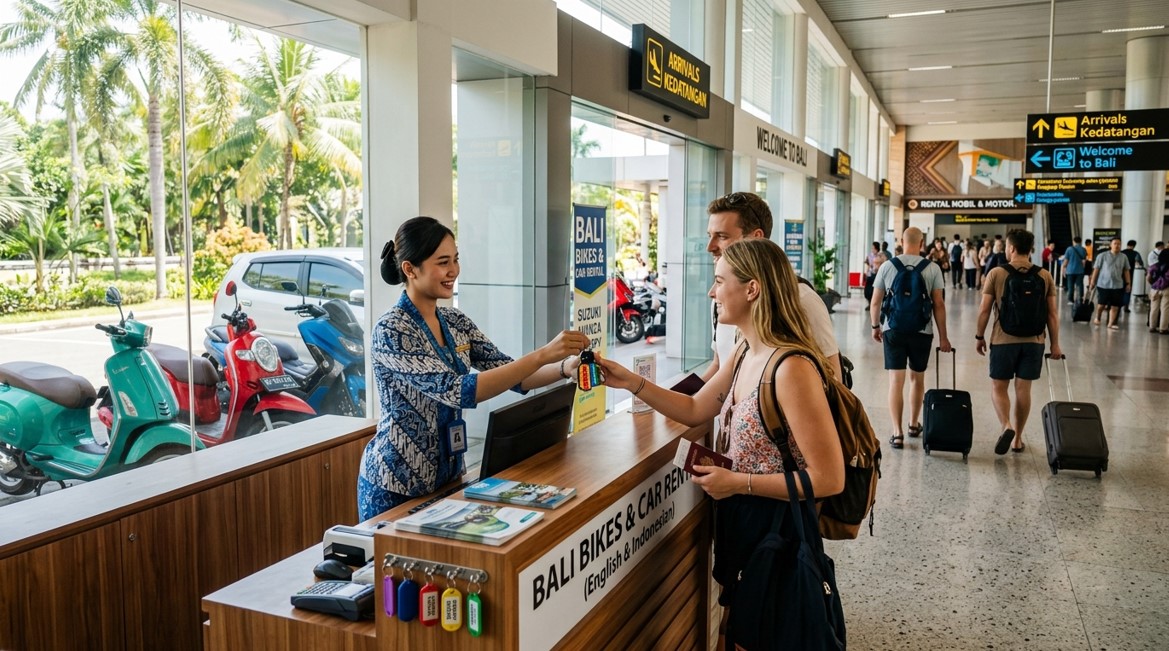
What Vehicle Rental Options Are Actually Available at Ngurah Rai Airport?
Three distinct rental models operate at DPS airport, each functioning differently in terms of location and service delivery. Physical rental counters from international companies like Avis and Budget occupy space inside the arrivals terminal near Gate 2, maintaining standard operating hours from 8 AM to 10 PM. These counters primarily handle car rentals with prices starting at IDR 300,000 daily for economy sedans and reaching IDR 900,000 for SUVs with automatic transmission.
The second model involves Indonesian rental companies that don’t maintain airport counters but operate through advance online booking with delivery directly to the arrivals curb. Services like Bikago, Bali4Ride, and Gotravela require travelers to book 24-48 hours before landing, then coordinate via WhatsApp for a meeting point outside the terminal. Their staff typically wait in the designated pick-up zone holding a sign with your booking reference number. This model dominates the scooter rental market, with prices ranging from IDR 50,000 to IDR 155,000 daily depending on engine capacity, from basic 110cc Honda Scoopy models to premium 160cc Yamaha NMax scooters with better suspension and storage.
The third option emerged in 2023-2024: rental kiosks positioned just outside the terminal exit, approximately 100 meters from the main doors in the short-term parking area. These operate on a walk-in basis without requiring advance bookings, though vehicle availability fluctuates significantly during peak season from July through September and December through January. Kiosks typically close by 8 PM, leaving late-night arrivals dependent on pre-booked delivery services or next-morning pickups from nearby Kuta locations along Jalan Kubu Anyar, where rental shop concentration reaches one per 50 meters in some sections.
Where Exactly Are Rental Counters Located in the Terminal?
International car rental counters occupy the southern end of the arrivals hall, positioned after customs exit and before the main terminal doors. After collecting luggage and clearing immigration, travelers exit through automatic doors into the arrivals area where counters appear on the left side, marked with company logos suspended from the ceiling. The walking distance from customs to these counters averages 150 meters, requiring approximately three minutes at normal pace.
For pre-booked scooter delivery, the meeting point shifts outside the terminal building. Exit through the main doors, continue straight past the taxi coordinator desk, and proceed to the designated pick-up zone marked with blue signage reading “Private Car & Motorcycle Pickup.” This zone extends roughly 30 meters along the curb, positioned between the official taxi rank and the short-term parking entrance. Airport security permits rental staff to wait here for a maximum of 30 minutes, after which they must circle back or relocate to the nearby parking structure. This timing creates pressure for travelers who experience immigration delays or luggage issues, occasionally requiring extended coordination through messaging apps to synchronize arrival and vehicle delivery.
Pre-Booking Online vs. Walk-In: Which Gives You Better Rates and Selection?
Pre-booking through platforms like Klook, Traveloka, or directly with rental companies typically secures 15-25% lower rates compared to walk-in airport pricing. A Honda Vario 125cc scooter booked 72 hours in advance costs approximately IDR 50,000-60,000 per day for weekly rentals, while the same vehicle at an airport kiosk demands IDR 75,000-85,000 daily. This price differential stems from airport location premiums—rental operations must absorb parking fees, staff transportation costs, and higher licensing requirements for airport zone operations.
Vehicle selection tells a more complex story. Pre-booking guarantees your reserved vehicle class but not the specific unit or its exact condition. Online listings show “new Honda Vario” with stock photos, yet the delivered scooter might display 15,000 kilometers on the odometer with minor cosmetic wear. Walk-in rentals allow immediate physical inspection, letting you reject vehicles with excessive scratches, worn tires with tread depth below 2mm, or non-functioning turn signals. This inspection opportunity matters significantly in Bali’s rental environment, where approximately 30% of tourist damage disputes originate from pre-existing wear that wasn’t documented at handover.
The availability compromise cuts both ways depending on season. During Bali’s peak periods (December 20-January 10, July 1-August 20), pre-booking becomes essentially mandatory as airport walk-in options frequently sell out by 2 PM. Conversely, during shoulder months like February, April, May, and October, walk-in customers gain negotiating leverage, occasionally securing 20% discounts from posted rates when rental staff face empty inventory overnight. The optimal strategy combines these approaches: pre-book a guaranteed option, then upon arrival, briefly survey walk-in counters before committing, canceling the online booking if a superior walk-in deal materializes within the 30-60 minute free cancellation window most platforms provide.
What Documents Do You Legally Need to Rent a Vehicle in Bali?
Indonesian traffic law requires three documents for legal vehicle operation by foreign nationals: a valid passport, your home country’s driver’s license, and an International Driving Permit issued under either the 1949 Geneva Convention or 1968 Vienna Convention, depending on your country of origin. The IDP must display the specific vehicle category endorsement—Category A for motorcycles and scooters, Category B for passenger cars. These documents work in combination, not as alternatives; possessing an IDP without your original domestic license provides no legal standing, as the IDP functions as a translation document rather than a standalone license.
Rental companies demonstrate highly variable document enforcement. International airport counters from Avis, Hertz, and Budget typically require strict verification of all three documents before releasing vehicles, with staff photographing each document for their records and insurance compliance. Indonesian rental services operating through delivery models show inconsistent practices—premium operators like Bikago mandate IDP verification during booking and again at handover, while budget providers sometimes accept only a passport and domestic license, particularly for scooter rentals under 125cc. This inconsistency creates a false sense of legality; even if a rental company accepts inadequate documentation, traffic police retain full authority to fine riders lacking proper permits.
The verification gap between rental requirements and police enforcement has widened since 2023 when Indonesian authorities intensified documentation checks in high-tourist zones around Seminyak, Canggu, and Ubud. Rental companies that skip IDP verification essentially transfer legal risk entirely to customers, collecting rental fees while leaving riders exposed to fines ranging from IDR 500,000 to IDR 1,000,000 per violation. This represents a fundamental misalignment of incentives: rental operators maximize booking conversion by reducing document barriers, while customers unknowingly accept legal liability that materializes only when encountering police checkpoints.
| Requirement | Details |
|---|---|
| International passport | Scanned copy of the page with photo and personal details. Required for identity verification before transport handover. |
| Driver’s license | Copy with open category A (motorcycle) or category B (car). Must match the type of vehicle being rented. |
| International Driving Permit (IDP) | ⚠️ Mandatory for Russian citizens under the Vienna Convention of 1968. Without IDP — fines and voided insurance. |
| 🇮🇩 Alternative to IDP | Indonesian SIM C (motorcycle) or SIM A (car). Issued in 3–5 hours after arrival, requires in-person biometrics. |
| Flight details | Flight number and exact landing time. Used to calculate the meeting time accounting for 60–90 minutes for immigration and baggage. |
| Deposit | 30% of the rental cost. Held on card or transferred via international payment systems. |
| Prepayment methods | Wise, PayPal, USDT, bank card. Crypto channels available for clients from jurisdictions with limited banking access. |
| Full payment | ✅ Cash in IDR or USD upon vehicle handover. Paid directly to the courier at the airport meeting point. |
| Exchange rate fixation | Locked at the moment of booking, not handover. Protects against currency fluctuations between order and arrival. |
Is an International Driving Permit (IDP) Truly Mandatory or Just Recommended?
The IDP holds mandatory legal status under Indonesian traffic regulation UU No. 22 Tahun 2009, which explicitly prohibits foreigners from operating motor vehicles with only a domestic license. Enforcement data from Bali’s regional police indicates approximately 15,000 traffic stops annually involving tourists without proper documentation, with the violation rate highest among scooter riders who perceive motorcycles as requiring less formal licensing compared to cars.
Obtaining an IDP before departure costs between $20-$30 USD (approximately IDR 300,000-450,000) from authorized automobile associations in your home country, requiring one passport photo and a valid domestic license. The application process typically completes within 20 minutes for in-person requests or 5-7 business days for mail processing. This upfront investment contrasts sharply with the Indonesian alternative: tourists technically can obtain a local Indonesian motorcycle license (SIM C) by visiting a regional police traffic office (Satpas), passing a written test and practical riding evaluation, and paying approximately IDR 200,000. However, this process requires minimum B211A tourist visa status (not visa-on-arrival), Indonesian language capability for the written examination, and typically 4-6 hours spread across two separate visits for testing and license issuance.
The practical reality makes home-country IDP acquisition the only viable path for standard tourist visits. Attempting to operate vehicles without an IDP doesn’t simply risk fines—it potentially voids rental insurance coverage, exposes you to personal liability for third-party damages that can reach millions of rupiah, and creates complications if involved in any traffic accident requiring police reports. Insurance companies routinely deny claims when investigation reveals the driver lacked proper licensing at the time of incident, transforming a minor scrape into a five-figure personal expense.
What Happens If Police Stop You Without Proper Documentation?
Indonesian traffic police conduct systematic checkpoint operations daily, particularly along major routes connecting Seminyak to Canggu, the coastal road from Sanur to Nusa Dua, and the mountain routes approaching Ubud. These checkpoints specifically target foreign riders, with officers requesting three documents in sequence: vehicle registration (STNK, which rental companies should provide), driver’s license, and International Driving Permit. Missing any document triggers an official traffic violation under different regulation codes—lacking an IDP falls under Article 288 of Traffic Law No. 22/2009.
The official fine structure specifies IDR 250,000 for riding without proper licensing, processed through a formal citation (tilang) that requires appearing at a district court or police station to pay within 14 days. However, roadside enforcement demonstrates significant variation from this standard. Police officers frequently offer immediate settlement for amounts ranging from IDR 500,000 to IDR 1,000,000 per person, justified as combining multiple violations—no IDP, no helmet camera (a regulation selectively enforced), or alleged traffic infractions like crossing solid lines or unclear hand signals.
This on-spot payment system operates in a legal gray zone. Officers issue handwritten receipts for amounts that rarely match official fine schedules, and tourists lacking Indonesian language skills struggle to distinguish legitimate expedited fines from unofficial payments. The financial calculation from an officer’s perspective involves assessing perceived tourist wealth based on vehicle type (newer scooters suggest higher ability to pay), group size (solo riders face higher pressure than couples), and nationality (certain passport holders face more aggressive fine requests based on perceived income levels).
Refusing immediate payment and insisting on the formal tilang process remains legally sound but practically complex. Officers must allow this option, providing a formal citation that requires traveling to the designated police station during business hours (typically 8 AM – 3 PM, Monday-Friday) to pay the lower official fine. However, this process consumes 2-4 hours including travel and waiting time, and requires surrendering your vehicle temporarily while documentation processes. For tourists on limited vacation time, losing half a day to save IDR 250,000-500,000 rarely makes practical sense, creating the economic leverage that sustains the immediate settlement system. The documented average payment at roadside stops currently sits at IDR 750,000 based on tourist reports across multiple Bali travel forums during 2024-2025.
Step-by-Step: The Actual Process from Landing to Getting Your Keys
The rental acquisition timeline begins not at the counter but during descent, when you should message your rental company via WhatsApp (for pre-booked deliveries) confirming your flight has landed and you’re proceeding through immigration. This heads-up triggers their delivery driver to depart from waiting areas and begin the 15-20 minute journey to the airport terminal, synchronizing their arrival with your customs clearance.
After collecting luggage and passing customs, you’ll enter the arrivals hall where cellular connectivity immediately becomes crucial. Ngurah Rai Airport provides free WiFi (network: “@Airport Free WiFi”), though connection quality degrades during peak hours when hundreds of passengers simultaneously attempt access. Indonesian SIM cards from Telkomsel, XL, or Indosat purchased at airport kiosks before exiting the terminal (located immediately after customs, on the left side) cost IDR 50,000-100,000 and provide immediate data connectivity, eliminating dependency on congested airport WiFi for coordinating with rental staff.
For international counter rentals, proceed directly to the company desks where staff will verify your documents, photocopy or photograph your passport, domestic license, and IDP. They’ll present a rental agreement typically spanning 3-4 pages in Indonesian and English, detailing daily rates, insurance coverage terms, fuel policy (nearly always “return with same fuel level as provided”), and damage liability clauses. Critical sections to read before signing include the excess/deductible amount you’ll pay for damages before insurance activates (commonly IDR 1,000,000-3,000,000 for cars, IDR 500,000-1,000,000 for scooters), the definition of what constitutes “normal wear” versus chargeable damage, and the return procedure including grace periods before late fees apply.
Payment processing follows document verification. International counters accept major credit cards (Visa, Mastercard) and typically place a hold authorization for the deposit amount plus estimated rental total. This hold doesn’t immediately withdraw funds but blocks that amount on your card for 7-14 days post-rental until the company confirms no damages. For a five-day car rental at IDR 400,000 daily with a IDR 2,000,000 deposit, expect a hold of approximately IDR 4,000,000 (about $250 USD). Budget Indonesian operators often require cash payment in full, accepting IDR or USD, creating a challenge for recently-arrived tourists who haven’t yet visited ATMs. Airport ATMs located inside the terminal near the exit charge standard Indonesian withdrawal fees (IDR 15,000-30,000 per transaction) with maximum single withdrawals typically capped at IDR 3,000,000, potentially requiring multiple transactions for week-long rentals with deposits.
Vehicle handover represents the most legally significant moment of the entire process. Staff will walk you to the vehicle location—parking structure for airport counter rentals, curbside for deliveries—and conduct a condition inspection. They’ll circle the vehicle noting existing damage on a diagram, photograph all scratches, dents, or worn components, and have you sign confirming accuracy. This document becomes your only defense against later damage claims. Tourists who skip thorough personal verification frequently discover new “damages” during return, with rental companies producing photos that may or may not accurately represent the vehicle’s condition at pickup. The inspection should specifically check tire tread depth (run your finger across the grooves; if smooth, reject the vehicle), brake function (test both front and rear on scooters before leaving the parking area), lights and turn signals (activate each individually), mirror condition (cracks compromise visibility and safety), and most critically on scooters, the undercarriage and exhaust pipe where scrapes from mounting curbs or speed bumps concentrate. Photograph or video the entire vehicle from multiple angles with the rental company’s name and your booking reference visible in the frame, creating timestamped evidence that protects against fabricated damage accusations.
How Long Does the Entire Rental Process Take at the Airport?
Timeline variables split between immigration processing, rental counter procedures, and vehicle preparation. Immigration clearance at DPS for tourist visa-on-arrival typically requires 20-45 minutes depending on flight arrival clustering—multiple wide-body aircraft landing within 30 minutes of each other can push immigration queues to 90 minutes during peak morning arrival windows between 8-11 AM. Electronic visa processing introduced in 2024 reduced average clearance time by approximately 35%, but system reliability issues still occasionally force fallback to manual processing.
Once in the arrivals hall, counter rental procedures consume 15-25 minutes for straightforward transactions where all documents verify correctly and no questions arise about insurance options or vehicle upgrades. Complex situations—additional driver registration, special insurance riders, or resolving document issues like IDP category mismatches—extend processing to 45+ minutes. Pre-booked delivery services generally move faster since document verification occurred during online booking; curbside handover typically completes within 10-15 minutes, primarily involving signature collection, deposit payment, and vehicle condition documentation.
The total timeline from touchdown to riding away averages 60-90 minutes for pre-booked scooter deliveries during normal traffic conditions, compared to 90-120 minutes for walk-in airport counter car rentals. Late-night arrivals after 10 PM face extended timelines if their pre-booked delivery encounters traffic on the airport approach road, and walk-in options become essentially unavailable as airport counters close. The 24/7 delivery services advertised by some operators charge premium rates for overnight handovers, typically adding IDR 50,000-100,000 to standard pricing for the inconvenience of staff night shifts.
The Evolution of Airport Transportation: How Bali Tourists Solved This 15 Years Ago
Before 2010, independent travelers landing at Ngurah Rai faced a constrained transportation monopoly. Official airport taxis operated through a fixed-price voucher system sold at counters inside the terminal, with rates to common destinations like Kuta, Seminyak, or Sanur ranging from IDR 75,000 to IDR 150,000—substantial amounts when the rupiah exchange rate gave travelers less favorable purchasing power. These vouchers theoretically prevented price gouging by establishing predetermined fares, but the system suffered from systematic overcharging through zone manipulation, where drivers claimed destinations fell into higher-priced zones despite maps suggesting otherwise. Tourists without Indonesian language skills had limited recourse for disputes.
This captive-market structure persisted because rental companies maintained operations exclusively in town, requiring tourists to first reach their accommodation before securing vehicles. The pattern forced a two-step transportation solution: expensive airport taxi to hotel, then next-morning scooter rental from shops concentrated in Kuta and Legian. This delay cost tourists their first day’s mobility and eliminated the option for direct transit to more distant locations like Ubud or Amed, essentially locking arrivals into staying near the airport initially regardless of their intended destination.
Several alternative solutions emerged between 2005-2015 attempting to break this taxi monopoly. Hotel transfer services gained popularity where accommodations sent private drivers to collect guests, typically charging IDR 100,000-200,000 bundled into room rates. This worked adequately for multi-day resort stays but provided no flexibility for travelers using short-term hostels or those planning to stay in multiple locations. Shared shuttle services launched around 2008-2009, promising fixed-route transportation to major tourist zones at lower per-person costs (approximately IDR 50,000 per traveler). These shuttles required collecting sufficient passengers to justify departure, creating wait times that stretched from 30 minutes to 2+ hours depending on arrival timing, and only served predetermined drop points rather than specific accommodations.
Why Airport Shuttle Services and Prepaid Taxi Vouchers Disappeared
The transportation transformation began with smartphone adoption and specifically the 2015 entry of ride-hailing apps Grab and Go-Jek into Bali’s market. These platforms fundamentally disrupted the airport taxi voucher economics by introducing transparent, GPS-tracked pricing approximately 30-40% below traditional taxi rates. A trip from DPS to Seminyak that cost IDR 150,000 via airport voucher dropped to IDR 80,000-100,000 through ride-hailing apps, with real-time driver tracking eliminating the opacity that enabled overcharging.
However, ride-hailing apps addressed only half the transportation challenge—they moved tourists from airport to destination but didn’t provide the multi-day mobility that scooter or car ownership enables. The genuine breakthrough came from rental companies adapting their business models to offer airport delivery starting around 2017-2018. This required regulatory navigation, as airport authorities initially prohibited rental companies from meeting customers in terminal areas, protecting the taxi monopoly. The compromise solution positioned rental handovers in designated zones outside the terminal building, technically off airport-controlled property while remaining within convenient walking distance.
Airport delivery service eliminated the fundamental friction that preserved taxi dominance: the forced separation between arrival and vehicle access. Tourists could now land at 2 PM and reach Ubud by 4 PM on their own scooter, immediately beginning independent exploration rather than losing arrival days to transportation logistics. This capability shift proved economically devastating to traditional services. By 2020, shared airport shuttles had essentially vanished due to insufficient passenger volumes, and official taxi operations contracted by approximately 60% based on airport authority revenue reports. The COVID-19 pandemic accelerated this transformation; when tourism resumed in 2022-2023, airport delivery had become the dominant model, now handling an estimated 65% of independent traveler first-mile transportation compared to roughly 15% in 2015.
The economic logic favoring this evolution becomes clear in a direct comparison. Consider a typical seven-day Bali itinerary staying in three different locations (Canggu, Ubud, Sanur). Under the 2010 model: airport taxi to Canggu (IDR 150,000), rent scooter for seven days (IDR 350,000 at IDR 50,000/day), taxis between accommodation changes (IDR 200,000 total), final taxi to airport (IDR 150,000)—total transportation cost IDR 850,000 with significant time lost to taxi coordination. The 2026 model: airport scooter delivery (IDR 350,000 for seven days), airport return (IDR 0, included in rental)—total cost IDR 350,000 with complete mobility freedom. The economic advantage of IDR 500,000 (approximately $32 USD) per trip, multiplied across millions of annual tourists, generated overwhelming market pressure that reshaped the entire airport transportation infrastructure within a decade.
Scooter vs. Car: Which Vehicle Type Matches Your Bali Itinerary?
Vehicle selection fundamentally determines your Bali navigation experience, with each option imposing distinct constraints on route choice, accommodation options, and daily logistics. Scooters offer unmatched advantages for solo travelers or couples moving through Bali’s congested southern corridor (Seminyak-Canggu-Kuta triangle) where traffic frequently achieves parking-lot density during 7-9 AM and 4-7 PM peak periods. A scooter navigates these jams by filtering through stopped car queues, reducing a 45-minute car journey to 20 minutes on two wheels. This time differential compounds across multi-stop days; visiting three beach clubs across Seminyak and Canggu consumes perhaps 90 minutes of total travel time on a scooter versus 2.5+ hours in a car when accounting for parking searches at each destination.
Parking economics further favor scooters. Beach clubs, restaurants, and attractions typically offer free scooter parking in dedicated areas with security attendants, while car parking costs IDR 5,000-20,000 per location. These fees appear minimal individually but accumulate to IDR 100,000-150,000 weekly for active tourists making 15-20 stops, effectively adding 30% to car rental costs. More significantly, some venues in areas like Canggu’s Batu Bolong neighborhood or Ubud’s central district have no car parking facilities at all, forcing drivers to park 200-500 meters away on side streets and walk, eliminating the convenience advantage that supposedly justified choosing four wheels.
Cars become the rational choice under specific condition sets that scooters handle poorly or dangerously. Groups of three or more travelers find cars economically superior; three people on two scooters (IDR 100,000-120,000 daily) plus double the parking fees exceed a single car rental (IDR 300,000-400,000 daily) while providing better luggage capacity and weather protection. Families with children under 12 face both safety and legal issues with scooters—Indonesian law prohibits children from riding as passengers unless they can reach the foot pegs independently, typically requiring height above 120cm, and proper child helmets remain scarce in rental fleets.
Understanding the Compromise: Mobility Freedom vs. Safety and Comfort
The scooter mobility advantage comes at a direct safety cost that many tourists underestimate. Bali recorded 1,876 tourist-involved traffic accidents in 2024 according to regional police data, with 82% involving scooters and 73% occurring within the first three days of rental. These statistics reflect multiple risk factors: left-hand traffic disorientation for right-hand-drive-country tourists, aggressive local driving patterns that assume predictive rather than reactive spacing, and road surface conditions that include sudden potholes, unmarked speed bumps (polisi tidur), and loose gravel at intersection corners.
New riders frequently overestimate their adaptation speed. Operating a scooter in Balinese traffic requires simultaneous attention to lane positioning (roads often lack marked lanes, with positioning determined by social negotiation), mirror checking (vehicles approach rapidly from both sides during filtering), surface scanning (obstacles appear with minimal warning), and ritual hand signals that substitute for often-broken turn indicators. This cognitive load typically exceeds untrained rider capacity during the first 10-20 hours of operation, creating the statistical spike in early-rental accidents. The medical costs from these incidents run IDR 5,000,000-20,000,000 for emergency room treatment of road rash, fractures, or head trauma, even with scooters moving at relatively low speeds of 30-40 kph during urban congestion.
Cars provide occupant protection through engineering rather than requiring operator skill—crumple zones, airbags, and seat belts create passive safety that functions even when drivers make errors. However, this safety comes by sacrificing the traffic-filtering capability that makes scooters time-efficient. During Bali’s notorious traffic congestion periods, car occupants simply sit immobilized in gridlock, breathing exhaust fumes with air conditioning fighting the tropical heat, watching scooters flow past. The psychological experience shifts from active exploration to passive endurance, transforming travel time into dead time rather than engaging navigation.
The honest compromise calculation requires matching vehicle choice to both skill level and itinerary demands. Tourists who’ve never operated motorcycles shouldn’t start in Bali’s chaotic traffic environment; the learning curve involves genuine injury risk that vacation insurance may not adequately cover. For these travelers, accepting car rental costs and time inefficiency provides better risk-adjusted outcomes than gaining scooter mobility through dangerous on-the-job training. Experienced riders from motorcycle-heavy countries (Vietnam, Thailand, Philippines, India) adapt much faster, typically achieving comfortable operation within 4-6 hours as they calibrate to Bali’s specific traffic culture. Intermediate skill levels might consider compromising through itinerary design: rent cars for arrival days while adjusting to left-hand traffic and local patterns, then transition to scooters once basic navigation confidence develops, or restrict scooter use to lower-traffic routes like the Ubud-to-Sidemen countryside corridor while using cars or ride-hailing for dense urban movement.
The Three Costliest Mistakes Tourists Make When Renting at Bali Airport
Economic losses from rental decisions concentrate in three systematic errors that tourists repeat despite extensive warning information available online. These mistakes persist because they offer false short-term savings that obscure much larger downstream costs, creating financial incentive structures that punish caution and reward corner-cutting—until the specific scenario emerges where the saved money proves catastrophically insufficient.
Mistake #1: Skipping the Pre-Rental Vehicle Inspection
Approximately 40% of tourists accept vehicle handover without conducting thorough damage documentation, either from exhaustion after long flights, pressure from rental staff eager to process multiple customers, or simple unfamiliarity with inspection protocols. This oversight stems from misplaced trust—rental companies seem professional and established, so surely they wouldn’t fabricate damage claims against customers. However, rental economics create structural incentives for damage attribution. Normal vehicle wear from dozens of previous renters accumulates scratches, scuffs, and scrapes that require periodic repair. Blaming this pre-existing damage on the most recent renter transfers repair costs from the rental company’s maintenance budget to customer deposits, improving profit margins by IDR 200,000-500,000 per incident.
The damage discovery typically occurs during vehicle return when staff conduct “final inspection” and identify scratches allegedly caused during your rental period. Without photographic evidence proving these scratches existed at pickup, you face a simple credibility contest: your word that damage was pre-existing versus the rental company’s documentation showing it now. Rental agreements include clauses specifying customer liability for undocumented damage, and Indonesian consumer protection laws provide minimal practical recourse for foreign tourists dealing with small-value disputes.
Calculate the actual cost: A claimed scratch on a scooter’s side panel leads to IDR 300,000-500,000 in “repair charges” deducted from your deposit. For car rentals, similar cosmetic damage claims range IDR 800,000-1,500,000. The rental company presents an invoice from a local body shop—often owned by relatives or business partners, with inflated pricing that exceeds actual market rates by 200-300%. The lost amount exceeds one-to-two weeks of typical rental fees, meaning a single inspection failure costs more than renting an entirely different vehicle would have cost. Across the estimated 50,000 annual tourists experiencing deposit deductions from disputed damage, total transferred costs reach approximately IDR 20-25 billion annually (roughly $1.3-1.6 million USD), representing pure economic loss from inadequate documentation practices.
Mistake #2: Accepting Minimal Insurance to Save 50,000 IDR Per Day
Rental companies present insurance as a binary choice: basic third-party coverage included in the base rate, or comprehensive coverage adding IDR 50,000-75,000 per day. Tourists calculate that declining comprehensive insurance saves IDR 350,000-525,000 on a week-long rental—meaningful money that could fund additional activities or meals. This calculation makes rational sense if nothing goes wrong, but it assigns zero probability to accidents despite statistical evidence showing roughly 8% of tourist vehicle rentals involve some form of incident requiring insurance claims.
Basic third-party liability insurance covers damages you cause to other people or property, but it provides zero coverage for damage to your rental vehicle. This means if you drop a scooter in a parking lot creating IDR 800,000 in scratched panels and broken mirrors, or scrape a rental car against a narrow gate causing IDR 2,500,000 in paint and body damage, you personally pay the full repair cost from your deposit or credit card. Comprehensive insurance (also called Collision Damage Waiver or CDW) covers these self-inflicted damages up to the vehicle’s value, typically with an excess/deductible of IDR 500,000-1,000,000 that represents your maximum out-of-pocket exposure.
The mathematical break-even analysis reveals declining comprehensive insurance as a negative expected-value gamble. At 8% incident probability, a tourist saving IDR 400,000 by skipping comprehensive coverage on a seven-day scooter rental faces a 92% chance of keeping that IDR 400,000, but an 8% chance of losing IDR 800,000 in uncovered damage costs. The expected value equals: (0.92 × IDR 400,000) + (0.08 × -IDR 400,000 [the saved amount minus the damage cost]) = IDR 368,000 – IDR 32,000 = +IDR 336,000. This looks marginally positive until you account for probability distribution—the 8% who experience incidents lose IDR 400,000 net (the IDR 400,000 they saved minus the IDR 800,000 they paid), while the 92% who avoid incidents gain only IDR 400,000. The downside scenario produces financial damage twice the magnitude of the upside scenario, creating asymmetric risk inappropriate for vacation spending where large unexpected costs substantially impact overall trip budgets.
The psychological element compounds this miscalculation. Tourists subconsciously assume careful driving prevents accidents, overestimating their control over outcomes. However, Bali accidents frequently result from environmental factors outside rider control: another vehicle entering your lane, diesel spills creating slippery road surfaces, sudden pedestrian movements, or dogs darting into traffic. Your skill level determines only partial accident probability; external chaos contributes substantially. Comprehensive insurance essentially charges IDR 50,000-75,000 daily to cap your maximum possible loss at the excess amount rather than the vehicle’s full value. For tourists whose total trip budget might be $1,500-2,000 USD, a single uninsured accident consuming $100-150 USD (IDR 1,500,000-2,400,000) represents 7-10% of their entire financial capacity, potentially forcing early departure or elimination of planned activities to cover unexpected repair costs.
Mistake #3: Choosing the Cheapest Counter Without License Verification
Price competition among Bali rental operators produces a race-to-the-bottom dynamic where the lowest-cost providers achieve pricing advantage by eliminating safety and compliance costs. A scooter rented at IDR 40,000 daily (approximately 30% below market average of IDR 55,000-65,000) typically indicates the operator has cut essential expenses: they skip IDP verification to avoid turning away undocumented customers, they provide vehicles with deferred maintenance to reduce repair expenditure, and they carry minimal or fraudulent insurance coverage that won’t pay claims during actual incidents.
The immediate consequence of renting from non-verifying operators is carrying legal liability without understanding its magnitude. When police stop you at checkpoints and discover missing documentation, the fine becomes your responsibility even though the rental company facilitated illegal operation by providing a vehicle without proper license verification. The rental company faces no penalty—they already collected your payment, and Indonesian law assigns traffic violation responsibility to the vehicle operator, not the owner. This asymmetric accountability creates moral hazard where rental companies maximize revenue by serving every customer regardless of legal qualification, then externalize the resulting legal costs onto those customers.
The insurance fraud dimension introduces catastrophic financial risk. Budget operators advertising comprehensive insurance at impossibly low rates (IDR 20,000-30,000 daily versus market rates of IDR 50,000-75,000) frequently operate without actual insurance policies. They collect insurance premiums from customers, but when accidents occur, they have no insurance company to file claims with. Instead, they demand full repair payment from customers, sometimes refusing to return passports or other collateral until payment clears. Tourists discover the fraud only after experiencing incidents, at which point they have minimal recourse—filing police reports requires time and Indonesian language capability most tourists lack, and pursuing civil claims against rental operators costs more than simply paying the demanded repair charges.
The true cost emerges through scenario analysis. Consider a tourist who saves IDR 100,000 over seven days by choosing the cheapest rental option (IDR 40,000/day instead of IDR 55,000/day). During day five, police stop them at a checkpoint and discover the missing IDP, demanding IDR 750,000 for immediate settlement. The tourist now faces a net loss of IDR 650,000 compared to if they’d rented from a compliant operator who would have required IDP verification before handover, preventing them from operating illegally. If an accident occurs, the situation worsens dramatically—fraudulent insurance means the tourist pays full repair costs (potentially IDR 2,000,000-5,000,000 for significant scooter damage or minor car damage) instead of just the IDR 500,000-1,000,000 excess they would’ve paid with legitimate comprehensive coverage. The IDR 100,000 saved through discount rental selection proves 20-50 times smaller than the resulting losses from cut-rate operator practices, representing perhaps the worst risk-reward ratio in Bali’s entire tourist economy.
The Contrarian View: Why Some Travel Experts Don’t Recommend Airport Rentals
A minority position among experienced Bali travel advisors argues against immediate airport vehicle rental, claiming the practice pressures tourists into operational readiness before they’ve adequately assessed local conditions. This perspective holds particular credibility among advisors who’ve witnessed serious tourist accidents and attribute them partially to immediate vehicle access that enabled unprepared exploration. Their central argument suggests that riding or driving in Bali requires acclimatization not just to left-hand traffic but to chaotic flow patterns, aggressive overtaking norms, and infrastructure deficiencies that don’t exist in most developed countries where tourists originate.
These experts recommend a staged approach: take a taxi or ride-hailing service from airport to accommodation, spend 24-48 hours observing Balinese traffic patterns as a pedestrian and passenger, potentially hire a driver for a day trip to experience roads from inside a vehicle while watching local navigation techniques, then rent a vehicle only after this observation period builds contextual understanding. This delay theoretically reduces accident risk by allowing mental calibration to Bali’s driving environment before taking direct control of a vehicle.
The acclimatization argument contains legitimate safety logic. Jet-lagged tourists making complex operating decisions—judging gap acceptances when merging into fast-moving traffic, estimating whether to brake or accelerate when approaching yellow lights, deciding when to filter between stopped cars—perform these judgments with reaction times and decision quality impaired by sleep deprivation. Adding the cognitive load of left-hand traffic navigation to this compromised state increases accident probability beyond the baseline 8% incident rate, though precise quantification remains difficult without controlled experimental data. Several prominent travel insurance companies report that approximately 12-15% of traffic accident claims involve incidents occurring within 6 hours of airport arrival, suggesting immediate post-flight operation carries elevated risk.
When Taking a Taxi First Actually Makes More Financial Sense
The delayed rental approach demonstrates superior economics under specific scenario conditions that approximately 25-30% of Bali tourists encounter. Travelers whose first three nights of accommodation sit in a walkable neighborhood with restaurant and activity access (parts of central Seminyak, Ubud’s core district, or Sanur’s beachfront zone) gain minimal utility from immediate vehicle access. A scooter parked unused for 72 hours while you explore on foot costs IDR 150,000-180,000 in rental fees that produce zero value, while a one-time airport taxi at IDR 100,000-120,000 followed by day-four vehicle rental captures the same transportation function at lower cost.
The calculation shifts dramatically for longer Bali stays exceeding 14 days. These extended visits typically involve changing accommodations 2-4 times as travelers explore different regions. Consider a three-week itinerary: five days Canggu, six days Ubud, four days Amed, five days Nusa Dua. Under immediate airport rental, you pay vehicle rental for all 21 days (IDR 1,050,000-1,260,000 for scooters, IDR 6,300,000-8,400,000 for cars). Under the delayed model with taxis for inter-region transit, you pay: airport taxi to Canggu (IDR 120,000), taxi Canggu-to-Ubud (IDR 400,000), rent scooter in Ubud for six days exploring surroundings (IDR 300,000), taxi Ubud-to-Amed (IDR 600,000), rent scooter in Amed for local exploration (IDR 200,000), taxi Amed-to-Nusa Dua (IDR 700,000), remain carless in resort zone (IDR 0)—total transportation cost IDR 2,320,000 versus scooter rental for 21 days at IDR 1,200,000, meaning the taxi-heavy approach costs nearly double.
However, this analysis overlooks the value of inter-city mobility freedom. With a personal vehicle, you can spontaneously detour to locations like Sidemen or Tirta Gangga while traveling between Ubud and Amed, transforming transit time into exploration. You can carry accumulated luggage and shopping purchases without worrying about taxi trunk capacity. You avoid the negotiation friction that accompanies arranging long-distance taxi trips, which often involve drivers demanding prices 30-50% above ride-hailing app estimates because apps serve shorter urban routes poorly outside the Seminyak-Kuta-Sanur triangle.
The honest assessment reveals that delaying rental makes financial sense almost exclusively for short stays (under five days) in geographically concentrated areas where walking and ride-hailing adequately serve transportation needs. Once itineraries extend beyond a single neighborhood or exceed one week duration, the flexibility and time savings from immediate airport rental justify the cost despite legitimate safety concerns about jet-lagged operation. The optimal compromise involves matching vehicle timing to when mobility actually becomes necessary: tourists heading straight to beachfront resorts in Nusa Dua or Jimbaran benefit from taxi transfers and day-three vehicle pickup after rest and orientation, while those staying in Canggu or Seminyak with immediate plans for beach club hopping gain utility from hour-one scooter access that justifies accepting slightly elevated operational risk during the adaptation period.
Insurance Options Decoded: What Coverage Actually Protects You
Insurance terminology in Bali rentals deliberately obscures coverage gaps through naming conventions that suggest comprehensive protection while delivering limited scope. “Full insurance” typically refers only to third-party liability coverage protecting you against claims from other parties injured or damaged by your vehicle operation, but providing zero coverage for damage to your rental vehicle itself. This naming exploits tourist assumptions that “full” means comprehensive, when it actually represents the minimum legal insurance requirement under Indonesian law.
True comprehensive protection requires specifically confirming Collision Damage Waiver (CDW) or Loss Damage Waiver (LDW) inclusion, which covers damage to your rental vehicle regardless of fault determination. These waivers operate differently from traditional insurance—rather than insurance companies paying claims, the rental company waives their right to recover repair costs from you beyond a predetermined excess amount. The excess typically ranges from IDR 500,000 to IDR 3,000,000 depending on vehicle value and rental company policy, representing your maximum financial exposure for any single incident regardless of actual damage severity.
However, CDW/LDW coverage contains systematic exclusions that void protection under common scenarios. Operating the vehicle without proper licensing (lacking valid IDP) invalidates coverage entirely, leaving you personally liable for full repair costs even if you purchased premium insurance. Alcohol involvement voids coverage even at blood alcohol concentrations below Indonesia’s legal limit of 0.05%. Driving outside paved roads into rural areas triggers exclusions in many policies, though rental agreements rarely clarify what constitutes “off-road” use—does a dirt road to a rice terrace viewpoint count? Ambiguity favors rental companies who interpret exclusions broadly when denying claims.
Basic Third-Party Liability vs. Comprehensive Damage Waiver
Third-party liability insurance serves a fundamentally different function than comprehensive coverage, protecting different financial interests under different loss scenarios. Third-party coverage (also called TPL—Third Party Liability) protects you against potentially unlimited financial liability when your vehicle operation causes injury or property damage to others. If you collide with another scooter causing the rider’s hospitalization requiring IDR 30,000,000 in medical treatment, or crash into a parked luxury car creating IDR 15,000,000 in repair bills, third-party coverage pays these claims instead of you personally owing those amounts.
This protection addresses the catastrophic risk tail—low-probability but financially devastating outcomes. While most accidents involve only minor scrapes or falls with minimal third-party damages, the severe incidents create liability exceeding most tourists’ available financial resources. Indonesian law holds vehicle operators personally liable for damages they cause; unlike some Western jurisdictions, lack of financial ability doesn’t excuse payment responsibility. Unpaid damage claims can theoretically result in civil lawsuits, though practical enforcement against foreign tourists proves difficult. The real risk emerges in serious injury cases where injured parties or their families pursue claims aggressively, potentially involving police reports that trigger visa complications or departure delays until financial settlements resolve.
Comprehensive damage waiver addresses the high-probability, moderate-cost scenario: damage to your rental vehicle. The statistics show approximately 8% of rentals involve vehicle damage, but average damage costs sit around IDR 800,000-2,500,000 for scooters and IDR 2,000,000-6,000,000 for cars—substantial amounts but not financially catastrophic for most tourists. Without CDW, you pay these amounts in full from your deposit or credit card. With CDW, you pay only the excess (typically IDR 500,000-1,500,000), and the rental company absorbs costs exceeding that threshold.
The expected value calculation for purchasing CDW depends on accident probability and excess structure. Consider a seven-day scooter rental where CDW costs IDR 50,000 daily (IDR 350,000 total) with a IDR 500,000 excess. Without CDW, the 8% accident probability means you have a 92% chance of paying zero damage costs, but an 8% chance of paying the average damage cost of IDR 1,500,000. Expected cost without CDW: (0.92 × IDR 0) + (0.08 × IDR 1,500,000) = IDR 120,000. With CDW, you pay IDR 350,000 upfront plus IDR 500,000 excess if an accident occurs (8% probability), giving expected cost: IDR 350,000 + (0.08 × IDR 500,000) = IDR 350,000 + IDR 40,000 = IDR 390,000. Pure expected value suggests declining CDW saves IDR 270,000 on average.
However, this analysis assumes risk-neutral preferences—treating a 92% chance of saving IDR 350,000 as equivalent to an 8% chance of losing IDR 1,150,000 (the IDR 1,500,000 damage cost minus the IDR 350,000 you would have paid for CDW). Most tourists exhibit risk-averse preferences during vacations, valuing certainty about maximum losses. CDW effectively functions as loss aversion insurance: you exchange the anxiety of potentially losing IDR 1,500,000 (which would significantly impact most trip budgets) for the certainty of losing only IDR 350,000 plus at most IDR 500,000 excess. For tourists whose total trip budget sits around $1,500-2,000 USD, capping maximum vehicle-damage exposure at roughly $55-60 USD (IDR 850,000 total) versus risking $95-100 USD (IDR 1,500,000) provides emotional value beyond pure expected value calculations. The peace of mind from knowing vehicle damage won’t consume 7-10% of your trip budget justifies paying a premium above expected cost, making CDW rational despite negative expected value for risk-averse travelers.
Real Pricing Breakdown: What You’ll Actually Pay in 2026
Actual rental costs demonstrate significant variation across vehicle type, rental duration, booking platform, and seasonal timing. For scooters, the market stratifies into three tiers. Economy models—primarily Honda Scoopy 110cc and older Yamaha Mio units—command IDR 45,000-60,000 daily for short-term rentals (1-3 days), dropping to IDR 35,000-50,000 daily for weekly bookings and reaching as low as IDR 25,000-35,000 daily for monthly commitments. These entry-tier scooters typically display 20,000+ kilometers on the odometer, show cosmetic wear, and feature dated body styling from 2018-2020 model years. They provide functional transportation but lack modern conveniences like USB charging ports, under-seat storage sufficient for full-face helmets, or digital instrument clusters.
Mid-tier scooters—predominantly Honda Vario 125cc, Yamaha Nmax 155cc, and Honda PCX 150cc—represent the most popular rental category, balancing performance and price at IDR 60,000-80,000 daily for short-term bookings, IDR 50,000-65,000 daily for weekly rentals, and IDR 40,000-55,000 daily for monthly contracts. These models offer larger wheels (typically 14-inch front, 13-inch rear versus 12-inch on economy models) providing better stability over rough roads, more powerful braking systems, and sufficient power for two-up riding including luggage up moderate inclines. Rental fleets typically stock 2021-2024 model years with 5,000-15,000 kilometers accumulated.
Premium scooters—Yamaha Nmax Connected (with smartphone integration), Honda Forza 250cc, or Vespa Sprint—command IDR 100,000-150,000 daily even for extended rentals, appealing primarily to tourists prioritizing comfort and style over budget. These feature superior suspension, larger displacement enabling highway-speed cruising, and aesthetic appeal for social media photography, though their additional capability rarely proves necessary for typical tourist routes within Bali where speed limits max at 60 kph and most travel occurs at 30-40 kph in traffic.
Car rental pricing follows a similar three-tier structure but with larger absolute amounts. Economy cars—primarily Toyota Agya, Daihatsu Ayla, and Honda Brio—rent for IDR 250,000-350,000 daily on short-term bookings, dropping to IDR 200,000-280,000 daily for weekly rentals. These subcompact manual transmission vehicles offer basic transportation for 2-3 passengers with minimal luggage, featuring air conditioning, manual windows, and aging infotainment systems without smartphone integration. Their primary advantage is four-wheel protection at the lowest possible price point, though cramped interiors and weak engines (typically 1.0-1.2 liters) struggle with Bali’s mountainous terrain and make highway merging stressful.
Mid-tier cars—Toyota Avanza, Daihatsu Xenia, Honda Mobilio—dominate the family rental market at IDR 350,000-500,000 daily for short-term bookings, IDR 300,000-420,000 daily weekly. These seven-seat MPVs (Multi-Purpose Vehicles) provide three rows of seating, trunk space adequate for multiple suitcases, and engines (1.3-1.5 liters) capable of maintaining highway speeds even with full passenger loads. Automatic transmission versions command premiums of IDR 50,000-80,000 daily over manual equivalents, with approximately 70% of tourists selecting automatics despite the added cost given unfamiliarity with manual transmission operation.
Premium cars—Toyota Fortuner, Mitsubishi Pajero Sport, Honda CR-V—cater to luxury-oriented tourists at IDR 700,000-1,200,000 daily depending on model year and features. These SUVs offer genuine capability for Bali’s challenging rural roads, all-wheel drive options, and status signaling that matters in some social contexts. However, their size proves disadvantageous in congested urban areas where parking becomes genuinely difficult and traffic filtering impossible, making them optimal primarily for tourists whose itineraries emphasize countryside exploration over beach club circuits.
Deposit Requirements and Payment Methods Accepted
Deposit structures vary systematically by rental company type and vehicle value. International airport counter operations from brands like Avis, Budget, and Europcar typically require deposits of IDR 3,000,000-5,000,000 for cars and IDR 1,000,000-2,000,000 for scooters, processed as credit card authorization holds that don’t actually debit your account but block those funds for 7-14 days post-rental. These companies accept Visa and Mastercard universally, with approximately 70% also accepting American Express and 40% accepting UnionPay for Chinese tourists. Debit cards face frequent rejection due to authorization hold complications, though some international operators accept debit cards if you agree to cash deposit alternatives.
Indonesian rental companies operating delivery models show wider deposit variation. Premium operators like Bikago require no deposit at all, instead implementing higher daily rental rates (typically IDR 10,000-20,000 above market average) that incorporate insurance premiums covering damage risk. This zero-deposit model attracts tourists who lack sufficient credit card limits for traditional holds or prefer not blocking funds for extended periods, though the total cost over week-long rentals typically exceeds traditional models by IDR 100,000-150,000 when accounting for the rate premium.
Budget Indonesian operators require cash deposits of IDR 500,000-1,500,000 for scooters and IDR 2,000,000-4,000,000 for cars, with deposit amounts often negotiable based on rental duration—monthly renters sometimes secure reduced deposits recognizing that longer commitments indicate lower default risk. These companies accept only cash (Indonesian Rupiah or US Dollars at varying exchange rates typically 3-5% worse than bank rates) or occasionally bank transfers to Indonesian accounts. The cash requirement creates logistical friction for arriving tourists who haven’t yet visited ATMs, though airport ATM clusters near the exit gates provide convenient withdrawal access with standard per-transaction limits of IDR 2,000,000-3,000,000.
Payment timing splits between upfront full payment (common for pre-booked deliveries where companies want guaranteed revenue before dispatching staff to airport) and daily-rate-on-pickup plus final-balance-on-return (typical for airport counter rentals where companies retain leverage through holding your documents until final payment clears). Upfront payment models expose customers to default risk if rental companies fail to deliver vehicles as promised or if vehicles prove unsuitable but companies refuse refunds, though this risk concentrates among unlicensed operators rather than established businesses with verifiable track records and online review histories.
The optimal payment strategy involves using credit cards wherever accepted despite processing fees some companies charge (typically 2-3% of transaction value). Credit card payments provide dispute resolution mechanisms through chargeback rights if rental companies engage in fraudulent damage claims or fail to return deposits appropriately. Cash payments offer no recourse—once you hand over IDR 2,000,000 cash deposit, you depend entirely on the rental company’s honesty for return, with no practical legal remedies if they fabricate damage claims and refuse to refund your money. The credit card processing fee of perhaps IDR 30,000-60,000 on a IDR 2,000,000 deposit effectively purchases insurance against deposit fraud, providing rational value despite feeling like unnecessary expense during the transaction moment.

Would you like to comment?