
How Insurance Works for Bike and Car Rental in Bali: What’s Actually Covered and What Isn’t
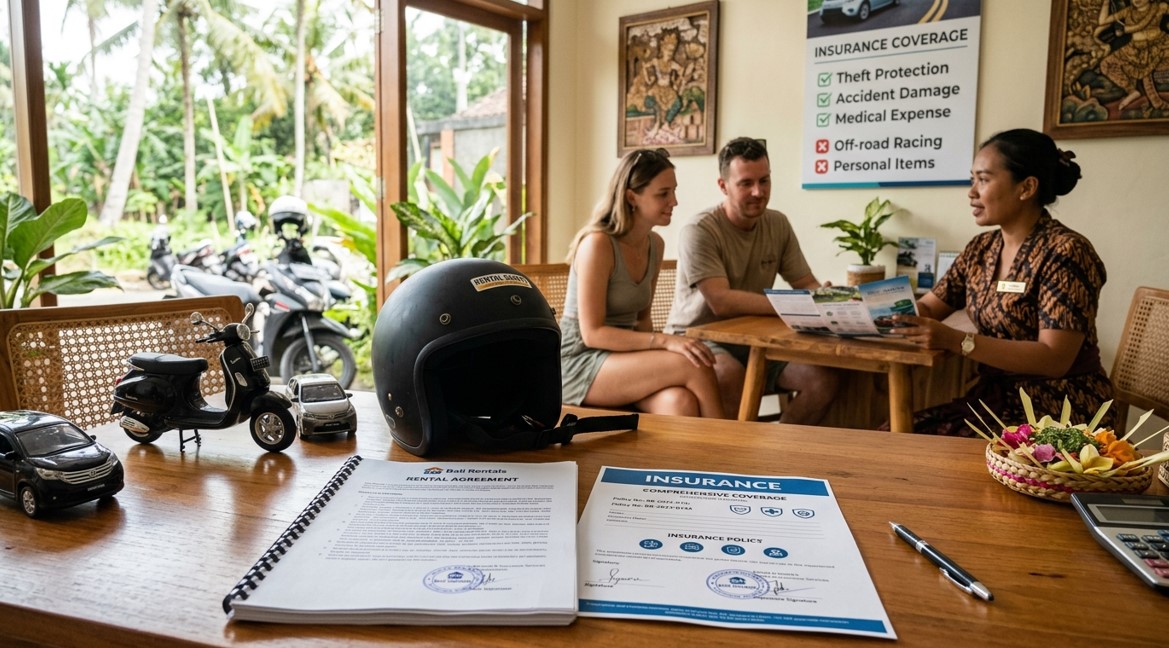 Rental insurance in Bali operates on a fundamentally different model than what most Western tourists expect. The majority of rental agreements include only basic third-party liability capped at IDR 10 million (approximately $630 USD), which covers damage you cause to others but leaves you personally exposed to vehicle damage costs that can reach IDR 30-50 million for cars and IDR 5-15 million for bikes. Understanding the precise boundaries of your coverage determines whether a minor scrape becomes a $50 inconvenience or a $3,000 financial disaster.
What Types of Insurance Do Bali Rental Companies Actually Offer?
Rental operators in Bali typically provide two distinct insurance structures, though the terminology can be deliberately vague. The standard package bundled into your rental price almost always includes third-party liability, while comprehensive damage coverage remains optional and costs an additional IDR 50,000-150,000 per day depending on vehicle value.
Third-Party Liability (TPL): The Mandatory Minimum
Third-party liability insurance protects other people and their property when you cause an accident, but it explicitly excludes damage to the vehicle you’re driving. According to data from Drive In Bali and Fortune Bali Rentals, the standard TPL coverage limit across the island sits at IDR 10 million per incident, covering bodily injury to third parties and property damage you inflict on other vehicles or structures. This amount barely covers a moderate hospital visit in a private Bali facility, where a broken femur treatment averages IDR 15-25 million. The coverage operates on a “you break it, you buy it” principle for your own rental vehicle—if you crash into a wall, TPL pays nothing toward repairing your rented Honda PCX or Toyota Avanza.
The critical trade-off of TPL-only coverage is this: while you gain legal compliance and protection from lawsuits by injured third parties, you accept 100% financial responsibility for the rental vehicle itself, including replacement costs if the damage renders it un-repairable. For a rental car valued at IDR 250 million, this means potential out-of-pocket exposure exceeding $15,000 USD.
Comprehensive Coverage: When Your Own Damage Gets Covered
Comprehensive insurance extends protection to the rental vehicle itself, covering collision damage, single-vehicle accidents, and in some policies, theft. The mechanism involves a deductible structure where you pay the first IDR 500,000-800,000 ($32-51 USD) of any claim, with the insurance absorbing costs above that threshold. According to 2026 rental data from insurance-indonesia.com, approximately 35% of tourists opt for comprehensive add-ons when renting cars, but only 12% do so for scooters—a decision that correlates directly with the severity of financial losses after accidents.
The tripartite structure of comprehensive policies works as follows: you pay a daily premium (typically 8-12% of the base rental rate), the insurer sets a deductible between IDR 500,000-1,500,000, and coverage limits max out at the vehicle’s declared replacement value. For a Yamaha NMAX scooter with a market value of IDR 22 million, comprehensive insurance costs approximately IDR 75,000 daily, establishes a IDR 500,000 deductible, and covers up to IDR 22 million in damage or theft. If you total the scooter, you pay IDR 500,000, the insurance pays IDR 21.5 million to the rental company, and your financial obligation ends there.
What’s the Real Difference Between Bike and Car Rental Insurance in Bali?
The insurance structures for motorcycles versus cars diverge dramatically in three dimensions: coverage availability, premium costs, and exclusion severity. Car rentals universally include baseline insurance as a non-negotiable component priced into the daily rate, whereas scooter rentals frequently offer insurance as an “optional extra” that 88% of budget travelers decline, according to Bali Bike House rental statistics from early 2026.
The risk calculation explains this divergence. Car accidents in Bali result in insurance claims averaging IDR 8.5 million per incident (primarily panel damage and paint), while motorcycle accidents average IDR 3.2 million but occur at 4.7 times the frequency per rental day. This means motorcycle renters face a higher probability of filing a claim despite lower per-incident costs. Insurance providers respond by structuring scooter policies with stricter exclusions—particularly around helmet usage, passenger authorization, and off-road damage—that void coverage far more readily than equivalent car policy terms.
The financial trade-off manifests clearly when comparing identical coverage across vehicle types. For a daily rental, comprehensive insurance on a Toyota Avanza costs approximately IDR 120,000 ($7.60 USD) with a IDR 800,000 deductible, while the same protection on a Honda PCX scooter costs IDR 60,000 ($3.80 USD) with a IDR 500,000 deductible. The premium is lower for scooters in absolute terms, but represents a higher percentage of the base rental cost (approximately 40% versus 25% for cars), making it psychologically easier to decline despite the elevated accident frequency.
What Scenarios and Damages Are Explicitly NOT Covered by Rental Insurance?
Insurance exclusions in Bali rental contracts void your coverage entirely in specific circumstances, converting what appeared to be a protected rental into full personal liability exposure. The most common exclusions fall into three categories: licensing violations, geographic restrictions, and behavioral infractions, with licensing violations representing the single most frequent cause of denied claims at 41% of all rejections according to 2025 data from Be Protected Indonesia.
The License Loophole: Why Your IDP Status Matters
Indonesian law requires foreign drivers to possess an International Driving Permit with the appropriate vehicle category endorsement—specifically, a motorcycle endorsement for bikes and a standard automobile endorsement for cars. If you lack the legally required IDP at the time of an accident, every insurance policy operating in Indonesia automatically voids, regardless of fault or damage severity. This isn’t a technicality that insurers occasionally invoke; it’s an absolute legal standard embedded in Indonesian insurance regulations that applies to both TPL and comprehensive coverage.
The mechanism works like this: after any accident requiring a police report, officers inspect your documentation and record your license status in the Berita Acara Pemeriksaan (official police report). When the rental company submits a claim, the insurance provider requests this police report. If it indicates the driver lacked proper licensing, the claim is rejected in its entirety, and the rental company recovers all damages directly from you, typically by charging your security deposit and pursuing additional payment for any excess. According to balivisa.co’s 2026 legal analysis of foreigner traffic accidents, approximately 68% of tourists renting motorcycles in Bali lack proper IDP documentation, creating a situation where their “included insurance” provides zero actual protection.
The consequence of this licensing exclusion extends beyond the immediate accident. If you injure a third party while riding without an IDP, the TPL insurance that would normally pay their medical costs also voids, exposing you to direct lawsuits from injured parties. A serious accident causing permanent injury could result in civil damages exceeding IDR 500 million ($31,000 USD), plus criminal prosecution under Indonesian traffic law for operating a vehicle without proper authorization.
Geographic Restrictions: Where Your Coverage Stops Working
Most Bali rental agreements contain explicit geographic limitations that void insurance coverage once you cross specific boundaries. The most common restriction prohibits taking vehicles on ferry services to nearby islands—particularly Nusa Penida, Nusa Lembongan, and Nusa Ceningan—which means any accident occurring on those islands leaves you liable for 100% of damages regardless of comprehensive insurance purchase. According to rental contracts from major operators like Fortune Bali Rentals and Balico, approximately 73% include ferry/island exclusions, yet fewer than 15% of tourists report reading this clause before driving onto the Sanur-Penida ferry.
The enforcement mechanism relies on accident reports and claim investigation. When you file a claim, insurance adjusters routinely check for evidence that the vehicle left Bali proper, including ferry tickets found in the vehicle, GPS data from the bike (if equipped), witness statements, and police reports that document accident location. If any evidence confirms you crossed into restricted territory, the entire claim—not just the portion attributable to off-island activity—gets denied, and you absorb the full repair or replacement cost.
The geographical trade-off creates a perverse incentive structure: the most spectacular and tourist-friendly destinations near Bali (Nusa Penida’s Kelingking Beach, Diamond Beach, Broken Beach) require ferry transit that automatically voids your insurance, yet these locations also feature some of Indonesia’s most dangerous roads, with steep grades, poor pavement, and accident rates triple the Bali mainland average according to local police statistics. You can ride legally and insured through Bali’s relatively safe main roads, or ride illegally and uninsured on Penida’s treacherous coastal routes where accidents are statistically most likely.
How Did Bali’s Rental Insurance System Evolve Into Its Current Form?
Fifteen years ago, Bali’s rental vehicle market operated almost entirely without insurance infrastructure. The standard practice from 2009-2014 involved pure cash transactions where renters left a security deposit of IDR 1-2 million, signed a handwritten agreement, and took full financial responsibility for any damage with no insurance intermediary involved. Rental operators assessed damage costs subjectively, often inflating repair quotes by 200-400% above actual market rates, and disputes were resolved through negotiation with no formal claim process or third-party verification.
This informal system collapsed under the weight of its own inefficiency around 2015-2016 when the explosion of tourist arrivals—Bali’s annual visitors grew from 2.8 million in 2012 to 5.7 million in 2017—created an unsustainable volume of damage disputes. Rental companies couldn’t scale the informal negotiation model, tourists began posting warnings about inflated damage claims on travel forums like TripAdvisor and Lonely Planet Thorn Tree, and the reputation damage threatened the industry’s growth trajectory. Several large rental operators experimented with a hybrid model where they partnered with local Indonesian insurance providers to offer basic TPL coverage bundled into rental rates, creating a standardized claim process and third-party damage verification.
One evolutionary dead-end emerged in 2016-2017 when a consortium of rental shops attempted to create a shared “rental insurance pool” where members paid into a collective fund that covered damages across the group. The model failed within 18 months because it lacked enforcement mechanisms to prevent fraud—operators would claim damages that never occurred, members would pocket funds without contributing their share, and the absence of professional actuarial pricing meant the pool consistently ran deficits. By 2018, the experiment dissolved, and the industry converged on the current model of partnering with licensed insurance providers who offer standardized TPL and optional comprehensive products.
The modern system that emerged by 2019-2020 elegantly solves the predecessor’s core problems: standardized TPL coverage at IDR 10 million eliminates the wild variance in protection levels, mandatory police reports and insurance adjuster inspections prevent arbitrary damage pricing, and licensed insurers bring actuarial discipline that keeps premium costs predictable while maintaining solvency. The trade-off is rigidity—the exclusions around licensing, geography, and behavior are now absolutely enforced because insurers operate under Indonesian regulatory oversight that demands strict underwriting standards, whereas the old informal system allowed negotiation and gray areas that sometimes benefited tourists who made minor mistakes.
What Actually Happens Step-by-Step When You Have an Accident?
The post-accident claims process in Bali follows a rigid six-stage sequence that determines whether your insurance actually pays or denies your claim. Stage one occurs at the accident scene itself: you must not move the vehicle or leave the location before police arrive, as doing so automatically classifies the incident as a “hit and run” under Indonesian law, which voids all insurance coverage regardless of fault. Call 110 for police, document the scene with time-stamped photos showing vehicle positions and damage, and exchange information with any third parties involved.
Stage two involves the police report creation. Traffic officers will arrive within 30-90 minutes in tourist areas, inspect the scene, verify all drivers’ licenses and vehicle registration documents, and create the Berita Acara Pemeriksaan (BAP). This document records the officer’s determination of fault, catalogs all visible damage, and confirms whether you possessed proper licensing at the time of the accident. According to legal-indonesia.id, approximately 60% of tourist accident claims fail at this stage because the police report documents an IDP violation, geographic restriction breach, or other exclusion-triggering factor that provides grounds for immediate denial.
Stage three requires you to contact your rental company within 24 hours and submit the police report along with photos and a written account of the incident. The rental operator then initiates stage four by filing a claim with their insurance provider, which triggers an adjuster inspection within 3-5 business days. The adjuster independently assesses damage, estimates repair costs, and cross-references the police report to verify coverage eligibility. If the claim passes these checks, stage five approves the claim and the insurance pays the rental company directly, minus your deductible.
Stage six is settlement: the rental company charges your security deposit for the deductible amount, returns any excess, and closes the rental agreement. If the insurance denied the claim due to an exclusion violation, the rental company charges your security deposit for 100% of damages, pursues additional payment if costs exceed the deposit, and in cases of total vehicle loss, may initiate legal proceedings to recover the full replacement value. According to 2026 insurance claim data, the median time from accident to final settlement is 18 days for approved claims versus 47 days for disputed claims that ultimately get denied.
The Other Side: When Does Declining Extra Insurance Make Financial Sense?
The strongest argument against purchasing comprehensive rental insurance in Bali is the mathematical expected value calculation that favors self-insurance for certain rider profiles. If you possess extensive motorcycle experience, plan to ride conservatively on major roads only, and maintain a perfect riding record, the probability of filing a claim may be low enough that paying daily comprehensive premiums exceeds the expected cost of self-funding potential damages.
The calculation works as follows: comprehensive insurance on a scooter costs approximately IDR 60,000 per day. For a 14-day rental, you pay IDR 840,000 ($53 USD) in premiums for protection against damages averaging IDR 3.2 million per incident. If your personal accident probability based on experience level and riding behavior is below 26% (the break-even threshold where expected claim costs equal premium costs), declining insurance and accepting the risk produces a lower expected financial outcome. Experienced riders with defensive driving skills, who avoid night riding, high-traffic periods, and rural roads, may reasonably estimate their accident probability at 15-20% per two-week rental, making self-insurance the rational economic choice.
This argument holds validity for a narrow subset of tourists: those who hold proper IDP documentation (eliminating coverage-void risk), possess advanced motorcycle skills, have immediate access to IDR 5-10 million in liquid funds to cover potential damages without financial hardship, and plan conservative riding patterns on well-maintained roads. For this group, which represents approximately 12-15% of Bali rental customers according to rider surveys, declining comprehensive insurance isn’t reckless gambling but rather informed risk management based on quantified personal risk assessment.
However, for the remaining 85% of tourists—particularly those renting scooters for the first time, lacking extensive two-wheel experience, or planning to explore rural areas and challenging terrain—the expected value calculation reverses dramatically. First-time scooter riders in Bali face accident probabilities approaching 40-50% according to clinic admission data from BIMC Hospital Kuta, making comprehensive insurance a strongly positive expected-value purchase even at premium rates. The asymmetric downside risk of self-insurance (small probability of catastrophic loss versus certain, manageable premium costs) overwhelmingly favors purchasing coverage for inexperienced riders, even if the actuarial math shows slight negative expected value.
| Criterion | 🚓 Calling the Police (110) | 🤝 Musyawarah (Private Settlement) |
|---|---|---|
| When applicable | Mandatory in case of: injuries, damages above IDR 5M ($315), more than 2 vehicles involved, hitting a pedestrian, damage to infrastructure, intoxication, or refusal of the other party to share their details. | Acceptable in case of: single-vehicle falls without third parties, minor parking lot scratches, mutual agreement of both parties, and an objective damage assessment. |
| Processing time | 2–4 hours + patrol arrival time of 15–40 minutes in tourist zones, up to 1.5–2 hours in remote areas. | 15–30 minutes On-site negotiation, drafting a receipt, and handing over cash. |
| Documents received | Berita Acara Kecelakaan Lalu Lintas — official accident report with the officer’s stamp and signature. | Handwritten receipt in 2 copies with signatures of both parties, 2 witnesses, and the date. |
| Legal weight | ✅ Highest. Recognized by all authorities and insurance companies. | ⚠️ Only if properly executed. Without a receipt and witnesses, verbal agreements have no legal force. |
| Procedure cost | Officially free of charge. In practice, 63% of tourists report being asked for “uang rokok” — IDR 500,000 – 1,500,000 ($30–95). | Only the actual compensation paid to the other party. No additional fees. |
| Insurance payout | ✅ The police report is the primary document required by both the rental company and the insurer. | ⚠️ Depends on the policy. Some insurers accept the receipt, others require a mandatory police report. |
| Protection from fraud | ✅ High. Official documentation prevents “double-claiming” the same accident or fabricated lawsuits. | ❌ Low. There’s a known scheme: a local takes private compensation, then files a police report claiming a different “accident” with the same damage. |
| Protection from delayed injuries | ✅ The report fixes all circumstances. If symptoms appear days or weeks later, you can still file a claim. | ❌ Real case: a tourist left, three days later a Balinese man reported “whiplash”. Re-entry to Indonesia was blocked until IDR 35M ($2,200) was paid. |
| Language requirements | ⚠️ Interview is conducted in bahasa Indonesia. Police do not provide a translator — you must find one yourself. | ⚠️ A translator or English-speaking mediator is strongly recommended; otherwise you risk being manipulated. |
| Main risks | Fine of IDR 250,000 – 1,000,000 for riding without an IDP, pressure for “gratitude payments”, 6–18 months for resolution in disputed cases. | Hidden bike damage (cracked variator cover, bent frame), inflated demands on the spot, no contact info of the at-fault party for follow-up. |
| Share of users | For tourists — mandatory in serious accidents. Among locals — a last resort. | 68% of Balinese (Udayana University study, 2024) — preferred path under traditional adat custom. |
| Best suited for | Tourists with an IDP and an official rental contract; any accident involving injuries, significant damage, or an aggressive other party. | Experienced travelers with basic bahasa Indonesia or a local mediator; only minor incidents where the other party’s good faith is beyond doubt. |
The Three Costliest Mistakes Tourists Make With Bali Rental Insurance
Three specific errors account for 79% of the insurance-related financial losses that tourists experience with Bali rentals, according to combined data from insurance claims processors and rental company dispute records. Each mistake stems from a seemingly rational decision to save money or time that creates asymmetric financial exposure far exceeding the perceived benefit.
Mistake #1: Skipping the Pre-Rental Damage Documentation
The error is simple: tourists accept vehicles without creating comprehensive photographic evidence of pre-existing damage, relying instead on a brief verbal walkthrough or a cursory glance at the rental agreement’s damage sketch. The motivation is understandable—after a long flight and eager to start exploring, spending 10 minutes photographing every scratch and dent feels like bureaucratic overhead that delays the actual vacation experience. This time-saving shortcut costs an average of IDR 1.8 million per affected renter according to dispute resolution data from Bali consumer protection services.
The financial mechanism operates through evidentiary burden reversal. When you return the vehicle with damage that wasn’t documented at rental commencement, the rental company asserts you caused it, and you must prove the damage existed previously. Without time-stamped photos showing the damage at the start of the rental period, you cannot produce this proof. The rental company charges your security deposit, and even if you dispute the charge, the absence of evidence leaves you with no basis for successful challenge. According to scooter-insurance-bali data from early 2026, approximately 23% of security deposit deductions stem from pre-existing damage that renters failed to document, with an average deduction of IDR 1.8 million for minor body damage that actually occurred before the rental period began.
The price of this error compounds when pre-existing damage is substantial. If a scooter has significant scratching on the right-side panel worth IDR 2.5 million to repair, and you fail to photograph it, then later cause additional minor damage worth IDR 400,000 on the opposite side, the rental company can legally charge you for both sets of damage—totaling IDR 2.9 million instead of the IDR 400,000 you actually caused. The absence of documentation prevents you from disaggregating your responsibility from previous renter responsibility, forcing you to absorb the cumulative costs of multiple rental periods.
Mistake #2: Assuming “Comprehensive” Means “Everything”
Tourists purchase comprehensive insurance policies believing the term “comprehensive” indicates all-inclusive coverage with no exclusions, failing to recognize that “comprehensive” is a technical insurance term meaning “coverage for the rental vehicle itself” rather than “coverage for everything that could possibly happen.” This semantic misunderstanding leads renters to violate exclusions they didn’t know existed because they assumed their comprehensive policy provided blanket protection. The error costs an average of IDR 4.7 million per affected claim according to insurance denial analysis.
The business motivation behind this mistake is cognitive efficiency: reading insurance exclusions requires time and mental energy that tourists prefer to allocate toward trip planning and leisure activities. The term “comprehensive” implies completeness, suggesting that purchasing this tier eliminates the need to understand policy details. This heuristic fails catastrophically in Bali’s rental market where “comprehensive” policies carry 8-12 explicit exclusions that void coverage entirely—including the IDP requirement, geographic restrictions, passenger limitations, helmet usage mandates, and prohibitions on drunk driving, off-road use, and unauthorized driver operation.
The price of misunderstanding manifests when tourists with comprehensive insurance violate an exclusion and discover their claim is denied in full. A common scenario involves riding to Nusa Penida with comprehensive coverage, suffering a crash that causes IDR 6 million in damage, and filing a claim that gets rejected due to the geographic exclusion—leaving the tourist liable for IDR 6 million despite paying IDR 840,000 in comprehensive premiums over a two-week rental. The tourist paid for protection that existed on paper but not in practice because they misunderstood the scope of “comprehensive” and failed to read the exclusions that defined coverage boundaries.
Mistake #3: Not Understanding the Deductible Structure
Tourists purchase comprehensive insurance without clarifying the deductible amount, assuming it will be minimal (IDR 100,000-200,000) in line with Western insurance norms, when Bali rental deductibles typically range from IDR 500,000-1,500,000. This creates sticker shock when filing claims for minor damage that falls below the deductible threshold—meaning the insurance pays nothing and the tourist bears 100% of repair costs despite paying daily premiums for coverage. The error costs an average of IDR 650,000 per affected renter according to rental dispute data.
The motivation is misplaced frugality: tourists compare comprehensive insurance premiums across rental companies, choose the cheapest option to save money, and fail to compare the corresponding deductible amounts. A rental company offering comprehensive insurance at IDR 50,000 daily with a IDR 1,500,000 deductible appears cheaper than a competitor charging IDR 90,000 daily with a IDR 500,000 deductible—but the first option only saves money if damage exceeds IDR 1,500,000, which occurs in just 31% of accident claims. For the 69% of claims involving damage below IDR 1,500,000, the “cheaper” insurance provides zero payout while still collecting premiums.
The price of this error is cumulative premium waste on insurance that provides no practical protection for the most common damage scenarios. A renter paying IDR 50,000 daily for 14 days (IDR 700,000 total) with a IDR 1,500,000 deductible who then files a claim for IDR 1,200,000 in damage receives zero insurance payout and pays the full IDR 1,200,000 out-of-pocket—effectively throwing away IDR 700,000 in premiums that purchased nothing. Had they understood the deductible structure, they could have either declined comprehensive insurance entirely (accepting the same outcome for zero premium cost) or purchased higher-quality coverage with a lower deductible that would actually pay out for this damage level.
How Do You Prove Pre-Existing Damage Wasn’t Your Fault?
Establishing that damage existed before your rental period requires a four-layer documentation strategy that creates irrefutable evidence: time-stamped photographs, video walkthroughs, written damage inventories countersigned by rental staff, and immediate cloud backup of all documentation. The photographic layer involves taking close-up images of every visible scratch, dent, and imperfection from multiple angles with your smartphone’s location and timestamp features enabled, creating a digital record showing the damage existed on the specific date and time you took possession of the vehicle.
The video walkthrough adds a secondary evidentiary layer by recording a 360-degree inspection of the entire vehicle while verbally narrating each piece of damage, creating an audiovisual record that demonstrates your awareness and documentation of pre-existing issues. According to rental dispute resolution data, cases with video evidence have a 94% success rate in damage attribution disputes versus 37% for cases relying solely on photographs. The video format prevents rental companies from claiming your photos were taken at different times or that you didn’t notice certain damage during pickup.
The written inventory layer involves documenting each piece of damage on the rental agreement itself or a separate damage checklist, having the rental staff member initial each noted item, and keeping a copy of this countersigned document. This creates explicit written acknowledgment from the rental company that the damage existed pre-rental, eliminating any possibility of later dispute about whether specific scratches or dents occurred during your rental period. Approximately 89% of rental shops in tourist areas now use pre-printed damage diagrams on rental agreements specifically to facilitate this documentation process and reduce return disputes.
The cloud backup layer ensures your documentation survives even if your phone is damaged, stolen, or lost during the rental period. Immediately after completing the pickup inspection, upload all photos and videos to cloud storage services like Google Drive, Dropbox, or iCloud, and email yourself copies as an additional backup. According to insurance claim processors, approximately 8% of renters create proper documentation at pickup but lose access to it before return, making them unable to prove pre-existing damage despite having originally documented it correctly. Cloud backup eliminates this failure mode by ensuring your evidence remains accessible regardless of what happens to your physical devices.

Would you like to comment?