
First Time Renting a Scooter in Bali: Which Model Is Best for Beginners and What Mistakes to Avoid
 Renting a scooter in Bali transforms how you experience the island, but first-timers face a landscape riddled with legal traps, mechanical failures, and financial pitfalls that experienced riders navigate instinctively. The difference between a liberating month of exploration and a confiscated vehicle at a police checkpoint often comes down to decisions made in the first ten minutes at the rental counter. Understanding which 110cc model offers the lowest center of gravity, why your home country driver’s license provides zero legal protection, and how a skipped pre-ride inspection can cost you $200 in fabricated damage claims separates confident riders from stranded tourists.
What Documents Do You Legally Need to Rent a Scooter in Bali?
You need three items to ride legally in Bali: a valid motorcycle license from your home country, an International Driving Permit with motorcycle category endorsement, and your passport. Indonesian law recognizes only this combination, and police checkpoints specifically target tourists in areas like Seminyak, Canggu, and Ubud during random enforcement operations that intensified significantly throughout 2025. Many rental shops will hand you keys with just a passport and cash deposit, creating a false sense of compliance that evaporates the moment a traffic officer requests your credentials.
Why Your Home Country License Alone Won’t Protect You at Police Checkpoints
Indonesian traffic law does not recognize foreign licenses as standalone documents for operating vehicles. According to enforcement patterns documented across Bali’s tourist zones, officers issue fines starting at IDR 1,000,000 (approximately $62 USD) to riders presenting only their domestic motorcycle license, regardless of whether that license is valid in countries like Australia, the United Kingdom, or the United States. The legal framework requires the IDP as a certified translation document that allows Indonesian authorities to verify your licensing category without language barriers. Choosing to ride without proper documentation transforms a simple traffic stop into a negotiation where you hold no legal position, and your scooter can be impounded until documentation issues are resolved, a process that typically takes multiple days and requires appearing at police administrative offices during limited operating hours.
How Long Does It Take to Obtain an IDP Before Your Trip?
Processing time for an International Driving Permit varies by issuing country but generally requires between one to six weeks when obtained through official channels like the AAA in the United States or national automobile associations in European countries. The document costs approximately $20-30 USD and remains valid for one year from the issue date. Applications submitted through legitimate channels require your existing motorcycle license, passport-sized photos, and completion of standardized forms that verify your licensing category matches the vehicle type you intend to operate. Avoid online services promising “instant digital IDPs” or “international licenses,” as these are commonly counterfeit documents that Indonesian police can identify immediately, resulting in the same penalties as riding without any permit at all while also making you complicit in document fraud.
Which Scooter Model Is Actually Easiest for Complete Beginners?
The Honda Beat 110cc and Yamaha Freego 125cc dominate beginner recommendations across Bali’s rental market because they combine automatic transmissions with low seat heights and forgiving power delivery. For riders with zero two-wheeled experience, the Honda Beat offers the most accessible entry point, with a seat height of 740mm that allows most adults to plant both feet flat on the ground at traffic lights, a psychological confidence factor that prevents the panicked grab-and-drop scenario that causes 40% of first-day accidents according to rental shop incident logs.
Why 110cc Automatic Scooters Dominate First-Timer Recommendations
Engine displacement directly affects weight distribution, throttle sensitivity, and low-speed maneuverability, three variables that determine whether a beginner maintains control in Bali’s chaotic traffic patterns. A 110cc automatic scooter weighs approximately 90-95 kilograms compared to 105-110 kilograms for 125cc models, and this 15-kilogram difference becomes critical when you need to hold the bike upright while stationary on an incline or navigate tight u-turns in congested temple parking areas. The smaller engine produces around 6.5 horsepower versus 8.5 horsepower in 125cc variants, creating a more predictable acceleration curve that prevents the lurching forward motion that occurs when nervous riders accidentally twist the throttle too aggressively while trying to stabilize the scooter with their feet.
Choosing a 110cc model over a 125cc configuration means accepting a trade-off: you sacrifice approximately 10 km/h of top-end speed and reduced confidence when climbing steep grades with a passenger, but you gain measurably better fuel economy (averaging 45-50 km per liter versus 38-42 km per liter) and a lighter physical footprint that makes parking maneuvers and slow-speed navigation through market streets significantly less stressful. For riders planning solo exploration of coastal routes and flat urban zones, this exchange favors the 110cc platform decisively.
Honda Beat vs Yamaha Freego: Which Offers Better Low-Speed Stability?
The Honda Beat employs a shorter wheelbase (1,265mm versus 1,275mm on the Freego) and positions its fuel tank lower in the chassis, creating a center of gravity that sits approximately 25mm closer to the ground. This geometric difference translates to noticeably easier handling when filtering through stopped traffic or making tight turns in crowded areas where you need to lean the scooter while maintaining control at walking pace. The Yamaha Freego counters with a wider front tire profile and slightly longer suspension travel, which provides better absorption of Bali’s notorious pothole-riddled roads and gravel patches that appear without warning on rural routes.
Test rides conducted across both models reveal that the Beat feels more “planted” during slow-speed maneuvers due to its lower center of mass, while the Freego offers superior comfort on longer rides exceeding 30 kilometers due to its more spacious footboard and seat width that reduces pressure points. Riders prioritizing urban confidence should bias toward the Beat, whereas those planning day trips to Ubud’s rice terraces or coastal roads will appreciate the Freego’s road-trip ergonomics.
What Seat Height Means for Confidence at Traffic Lights
Seat height determines whether you can stabilize a scooter with your feet while stopped without tiptoeing or shifting your weight dangerously to one side. Riders under 170cm (5’7″) frequently struggle with scooters featuring seat heights above 760mm, as the inability to achieve a flat-footed stance creates continuous anxiety at Bali’s frequent traffic lights and stop signs. This physical discomfort compounds when you add a passenger, as the combined weight shifts the bike’s balance point and requires stronger leg engagement to prevent tipping.
The Honda Beat’s 740mm seat height accommodates the widest range of rider statures, making it the default choice for anyone uncertain about their ability to manage a taller machine. The psychological impact of knowing you can firmly plant both feet cannot be overstated when you are navigating unfamiliar traffic patterns while processing new road rules and watching for erratic movements from surrounding vehicles.
From Chaos to Standardization: How Bali’s Scooter Rental Market Evolved
Between 2010 and 2016, Bali’s scooter rental ecosystem operated almost entirely without documentation requirements, insurance verification, or systematic vehicle maintenance protocols. Shops would hand over keys in exchange for cash deposits ranging from $50-100 USD, with zero verification of riding ability or licensing credentials. This frictionless system attracted massive tourist participation but created cascading problems: insurance companies refused to honor claims from unlicensed riders, hospitals treated mounting numbers of tourists with severe road injuries who lacked coverage, and police corruption flourished as officers exploited tourists’ illegal status for on-the-spot “fine” negotiations that rarely involved official receipts.
Why the 2015-2018 “No Documentation” Era Created Today’s Strict Requirements
The turning point arrived in 2017 when a series of high-profile accidents involving foreign tourists without proper licensing prompted Indonesian authorities to mandate stricter enforcement of existing traffic laws that had previously been ignored for tourism revenue reasons. Rental operators faced new liability exposure as courts began holding them partially responsible for damages caused by unlicensed riders they knowingly equipped. This legal shift forced legitimate rental businesses to implement documentation verification systems and pushed insurance providers to create products specifically designed for the tourist scooter rental market.
The unintended consequence of lax enforcement had been a complete disconnect between legal requirements and practical reality, fostering a culture where tourists genuinely believed riding without an IDP was acceptable “because everyone does it.” The post-2018 enforcement regime attempts to close this gap, though inconsistent checkpoint frequency means many riders still operate illegally until the day they encounter consequences.
The Failed Experiment with Electric Scooter Networks
Between 2019 and 2021, multiple startups attempted to establish app-based electric scooter sharing networks in Canggu and Seminyak, modeled after systems successful in European cities. These ventures collapsed within 18 months due to three critical factors: Bali’s electrical infrastructure couldn’t support dense charging station networks required for fleet operations, theft and vandalism rates exceeded 30% annually, and tourist users unfamiliar with electric acceleration curves caused a disproportionate accident rate during the first 500 meters of each rental. The experiment proved that Bali’s rental market requires human oversight at the transaction point rather than fully automated systems, and that gasoline scooters’ established refueling infrastructure provides reliability that electric alternatives cannot yet match in this specific geographic and cultural context.
What Should You Inspect Before Signing the Rental Agreement?
Before you sign anything or hand over deposit money, you must conduct a systematic mechanical inspection and photographic documentation session that takes approximately seven minutes but prevents the majority of post-rental disputes. Stand with the rental agent and create a shared understanding of the scooter’s existing condition, because any ambiguity will be resolved in the shop’s favor when you return the vehicle.
The 7-Point Mechanical Check That Prevents 80% of Breakdowns
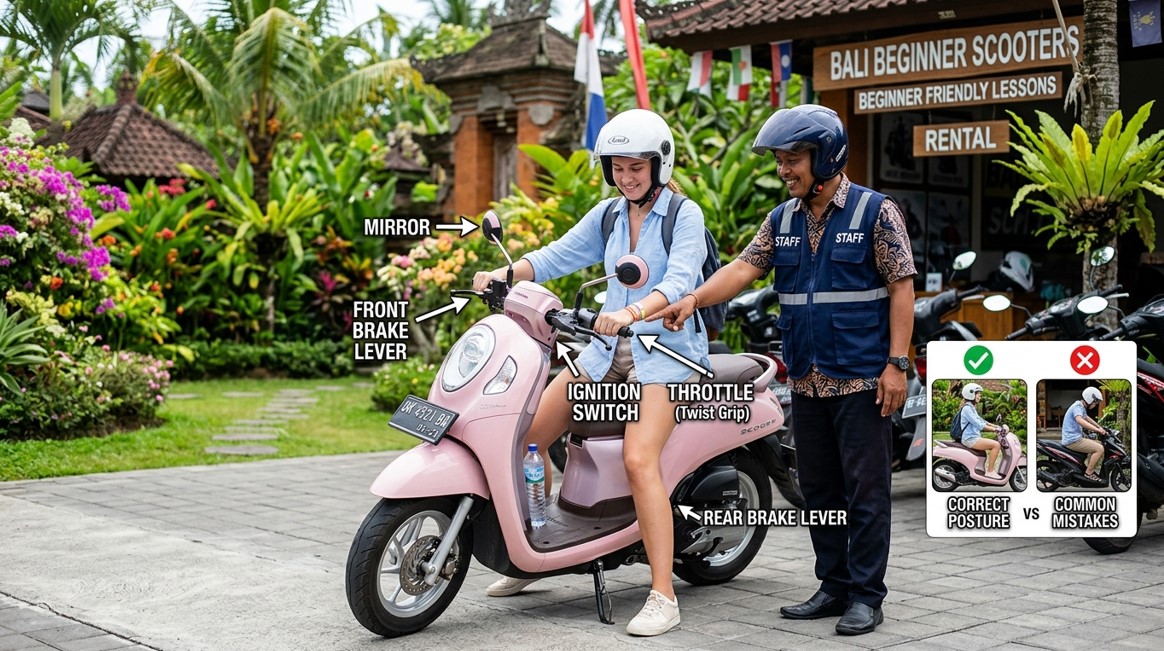
First, start the engine and listen for irregular sounds, particularly clicking or grinding noises from the transmission area that indicate worn CVT components likely to fail during your rental period. Second, test both brakes at full pressure while stationary, ensuring the front brake lever provides firm resistance without sponginess that signals air in the brake lines or worn pads. Third, check tire tread depth by inserting a coin into the grooves; if the tread doesn’t cover at least half the coin’s face, the tires are dangerously worn and will provide inadequate grip on wet roads.
Fourth, verify that all lights function correctly by having someone watch while you activate turn signals, brake lights, and headlights, as non-functional signals dramatically increase your accident risk and provide police with legitimate grounds for traffic stops. Fifth, inspect the throttle cable’s return action by twisting the grip and releasing it quickly; the throttle should snap back to idle position immediately without sticking, as a sticky throttle cable can cause unintended acceleration. Sixth, examine the body panels for cracks around mounting points, which indicate previous impact damage that may have affected frame integrity. Seventh, confirm the fuel gauge works and note the current fuel level, as some shops deliberately provide scooters with minimal fuel hoping you won’t notice until after signing.
How to Document Existing Scratches Using Your Phone’s Timestamp Feature
Modern smartphones embed GPS coordinates, date, and time data directly into photo metadata, creating irrefutable evidence of when and where each image was captured. Before you take possession, photograph every existing scratch, dent, or scuff mark from multiple angles, ensuring the scooter’s license plate appears in several shots to prove the photos document this specific vehicle. Pay particular attention to areas prone to cosmetic damage: mirror housings, side panels near the footpegs, and the front fender area, as these locations frequently become sources of dispute when shops claim you caused pre-existing damage.
Request that the rental agent physically point to each damaged area while you photograph, and consider recording a short video where you verbally narrate the inspection process while panning across the scooter. This video evidence provides context that static photos cannot capture and demonstrates your diligence in a format that proves extremely difficult to dispute. Send these photos immediately to your own email or cloud storage to establish an independent timestamp record that cannot be accused of manipulation.
| Criterion | 🛵 Honda Beat 110cc (urban beginner) | 🏍️ Yamaha Freego 125cc (touring beginner) |
|---|---|---|
| Engine displacement | ✅ 110cc, ~6.5 hp Predictable acceleration curve that prevents the lurching motion when nervous riders accidentally over-twist the throttle. |
⚠️ 125cc, ~8.5 hp More confident on steep grades with a passenger, but throttle response demands smoother wrist control from day one. |
| Curb weight | ✅ ~90–95 kg Critical 15 kg lighter when holding the bike upright on inclines or making tight u-turns in temple parking areas. |
⚠️ ~105–110 kg Heavier footprint requires stronger leg engagement at standstill, especially with luggage or a passenger. |
| Seat height | ✅ 740 mm Most adults plant both feet flat at traffic lights — the psychological factor that prevents the panicked grab-and-drop scenario. |
⚠️ ~760+ mm Riders under 170 cm (5’7″) frequently tiptoe at stops, creating continuous balance anxiety in dense traffic. |
| Wheelbase & geometry | ⏱️ 1,265 mm wheelbase Lower center of gravity (~25 mm closer to the ground) makes the bike feel “planted” while filtering through stopped traffic. |
⏱️ 1,275 mm wheelbase Wider front tire profile and longer suspension travel absorb pothole-riddled roads and gravel patches better. |
| Fuel economy | 💰 45–50 km per liter Lower running costs on long exploration days; one tank covers most South Bali itineraries without refueling stops. |
💰 38–42 km per liter ~15–20% higher fuel spend over a two-week rental, partially offset by fewer engine revs at cruising speed. |
| Top-end speed | ⚠️ Lower ceiling Sacrifices ~10 km/h of top speed; reduced confidence climbing steep grades with a passenger on board. |
✅ Higher cruising headroom Maintains pace comfortably on coastal stretches and bypass roads where 110cc scooters feel strained. |
| Slow-speed maneuvering | ✅ Best in class for novices Shorter wheelbase and lower fuel tank position make tight turns and walking-pace navigation noticeably easier. |
⚠️ Less agile at low speeds The longer chassis trades urban agility for highway stability — a poor trade in market-street congestion. |
| Long-ride comfort (30+ km) | ⚠️ Compact ergonomics Smaller footboard and narrower seat create pressure points on day trips to Ubud rice terraces or coastal routes. |
✅ Touring-grade comfort Spacious footboard and wider seat reduce fatigue on routes exceeding 30 km of continuous riding. |
| Two-up riding | ⚠️ Manageable but lively The combined weight shifts the balance point; requires confident leg engagement at every stop. |
✅ More stable with passenger Extra power and longer wheelbase translate into a more composed feel on inclines and overtaking maneuvers. |
| Best-case use scenario | 🏙️ Solo exploration of Seminyak, Canggu, Ubud town center; flat urban zones and short coastal hops. | 🌴 Day trips with a passenger to Uluwatu, Sidemen, or rice-terrace routes where comfort outranks agility. |
| Main risks | Underpowered for two-up climbing on steep inland roads; smaller tires more sensitive to deep potholes and wet gravel. | Heavier drop weight if you tip at standstill; taller seat compounds fear factor for first-ever riders. |
| Best suited for | Complete first-time riders, shorter statures (under 170 cm), urban-only itineraries, riders prioritizing low-speed confidence over long-distance comfort. | Riders with some prior two-wheel experience, taller statures, multi-day touring plans with a passenger, those prioritizing road-trip ergonomics over agility. |
The Three Mistakes That Cost First-Time Renters $200+ Each
Certain errors appear repeatedly across first-time rental experiences in Bali, and each carries quantifiable financial consequences that exceed what renters anticipate. These mistakes stem from prioritizing short-term savings over risk mitigation or failing to understand how Bali’s rental economy operates differently from vehicle rental markets in Western countries.
Mistake #1: Choosing the Cheapest Daily Rate Over Comprehensive Insurance
Budget rental shops advertising rates of 50,000-60,000 IDR per day (approximately $3-4 USD) generate revenue by excluding insurance coverage and maximizing deposit retention through aggressive damage claims. The calculation that makes this appear attractive—saving $2 per day over a two-week rental equals $28 saved—collapses entirely when you consider the financial exposure. Without insurance, you become personally liable for repair costs the shop determines without your input, typically starting at $100 for minor scratches and escalating to $300-500 for any damage requiring panel replacement.
The price of this mistake materializes when you return the scooter and the owner identifies a scratch you cannot definitively prove was pre-existing because you lack timestamped photo evidence. At this point, you face a binary choice: pay the demanded amount from your deposit, or refuse payment and attempt to dispute the claim while the shop retains your passport or blocks your departure. Most tourists pay immediately to avoid missing flights, which is precisely the leverage these operations exploit.
Comprehensive insurance from reputable operators costs an additional 25,000-35,000 IDR per day but caps your liability at zero for most damage scenarios and provides 24-hour roadside assistance. The mathematical reality: paying an extra $30 over a two-week period to eliminate $500 of potential liability represents a 1:16 risk-to-protection ratio that makes financial sense for anyone operating in an unfamiliar legal environment.
Mistake #2: Skipping the Test Ride Within the Shop’s Parking Area
Approximately 60% of first-time renters accept the scooter without performing a test ride, either due to embarrassment about their inexperience or eagerness to begin exploring. This decision costs them the only opportunity to identify mechanical issues before accepting responsibility for the vehicle’s condition. Problems that emerge during a five-minute test loop—sticky throttle cables, misaligned handlebars, weak brake response, or transmission hesitation—can be addressed by requesting a different unit or negotiating repair before departure.
The cost manifests when these issues cause accidents or breakdowns during your rental period. A sticky throttle cable that you discover while merging into traffic can cause you to rear-end another vehicle, generating repair costs and potential injury. A weak front brake you didn’t test might fail to stop you adequately on a downhill grade, leading to intersection accidents with damage liability that falls entirely on you as the renter. These scenarios carry average costs ranging from $150 for minor collision repairs to $800+ for accidents involving third-party vehicles or injuries.
Requesting a test ride demonstrates competence rather than weakness, and legitimate rental operations expect this behavior from careful customers. Shops that discourage or refuse test rides reveal their operational priorities clearly, and you should interpret this resistance as sufficient reason to find an alternative provider.
Mistake #3: Renting Long-Term Without Verifying the Owner’s Legal Registration
Monthly rentals offer substantial per-day savings—often 50-60% compared to daily rates—but introduce a different risk profile that many tourists overlook. When you commit to a 30-day rental, you must verify that the scooter carries current registration (STNK document) and that the rental operator owns the vehicle legally or holds explicit authorization from the registered owner to rent it commercially. Failing this verification can result in police impounding the scooter during routine checks when they discover registration irregularities, leaving you without transportation and no recourse for refunding your monthly payment.
The financial damage compounds because monthly rentals typically require full payment upfront—approximately $80-120 USD for the entire period—and when police impound a vehicle due to registration issues, the rental operator rarely provides refunds or replacement scooters. You absorb the full loss of your prepaid rental and must source alternative transportation at daily rates for the remaining rental period. This scenario converts what appeared to be a $100 monthly rental into a $250+ total outlay when you factor in the lost prepayment plus emergency daily rentals for the remaining two weeks.
Mitigating this risk requires examining the STNK document before payment and verifying that the registration remains valid through your entire rental period. The document displays expiration dates clearly, and if the shop cannot or will not produce this document for inspection, that inability tells you everything you need to know about their legitimacy.
The Strongest Argument Against Renting: Why Some Experts Recommend Private Drivers Instead
Transport safety analysts and travel insurance providers frequently advise against scooter rental for tourists arriving from countries with right-hand traffic patterns, arguing that the cognitive load of switching to left-hand traffic while simultaneously managing unfamiliar road conditions, aggressive local driving behavior, and a new vehicle creates an unacceptable accident risk. Statistical data from Bali’s BIMC Hospital network indicates that tourists on rented scooters represent a disproportionate percentage of road trauma cases, with riders from Australia, Europe, and North America showing similar injury patterns related to incorrect lane positioning and misjudged turning distances.
When Unfamiliarity with Left-Hand Traffic Outweighs Mobility Benefits
The counter-argument holds legitimacy in specific scenarios: riders with zero motorcycle experience attempting their first-ever two-wheeled journey in Bali’s traffic conditions face genuinely elevated risk compared to using car-based transport options. The first 72 hours represent the highest danger window, as your muscle memory fights against the correct traffic flow and you haven’t yet developed automatic scanning patterns for Bali’s unique hazards like aggressive overtaking from both directions simultaneously.
However, this analysis applies primarily to complete novices who possess neither motorcycle experience nor adaptability to left-hand traffic. For riders holding valid motorcycle licenses from their home countries, the transition to left-hand driving typically requires 4-6 hours of cautious practice in low-traffic areas before comfort develops. The mobility independence and cost savings—a scooter rental averages $5 per day versus $35-50 per day for private driver services—justify the measured risk for most scenarios where riders commit to gradual skill development rather than immediately tackling high-traffic routes.
The strongest position recognizes that scooter rental isn’t categorically wrong, but rather inappropriate for a subset of tourists who lack foundational riding skills or the patience to develop them systematically. Those willing to invest their first riding day on quiet neighborhood streets rather than immediately attempting the Seminyak-Uluwatu coastal route can successfully navigate the learning curve with acceptable risk levels.
Hotel Concierge vs Dedicated Rental Shop: Which Protects You Better?
Hotel-facilitated scooter rentals offer convenience through on-site delivery and pickup, but this streamlined process typically costs 30-50% more than identical scooters from dedicated rental shops while providing less transparency about insurance terms and mechanical condition. Concierge services act as intermediaries, marking up rates from their partner rental suppliers and taking commissions that inflate your daily cost from the market rate of 70,000-80,000 IDR to 100,000-120,000 IDR without corresponding improvements in vehicle quality or legal protection.
The hidden cost emerges in accountability structures. When disputes arise over damage claims or mechanical failures, the concierge refers you back to the actual rental company, eliminating the buffer you assumed you were paying premium prices to obtain. Dedicated rental shops establish direct relationships where you negotiate terms, inspect vehicles personally, and maintain sole contact with the party responsible for the scooter’s condition and your contractual obligations.
Reputable dedicated shops like those operating transparently in Canggu, Seminyak, and Ubud for multiple years provide verifiable Google reviews, display business licenses publicly, and offer detailed rental agreements in English that specify insurance coverage limits, damage liability caps, and emergency contact protocols. These operational markers—public reputation, transparent pricing, and documented terms—create accountability that concierge arrangements cannot match regardless of the hotel’s star rating. The optimal approach prioritizes verified reputation over convenience, accepting the minor inconvenience of visiting a rental shop directly to gain material improvements in legal protection and cost efficiency.

Would you like to comment?